The Terrarium
Tall, planted, bright and warm at the top. Build a slice of tropical canopy.
Everything about housing this skink follows from one fact: it lives up. Vertical space, climbing surfaces, a warm well-lit top zone and a humid, planted body are the priorities. Floor area matters far less than height and structure.
Enclosure size
These are social animals: keep two or more, never a single skink. So sizes start at a pair; scale up for a group.
| Group | Minimum (W × D × H) | Better |
|---|---|---|
| Pair (the minimum) | 60 × 45 × 90 cm | 90 × 45 × 90 cm+ |
| Small group (3–4) | 90 × 45 × 90 cm | 120 × 60 × 120 cm+ |
Height always beats footprint for an arboreal species. A tall, front- opening glass or PVC terrarium with good ventilation is ideal. Bigger is genuinely better here, more space means more thermal and humidity choices, and enough room for every animal in a group to have its own basking spot and retreat.
Décor & climbing structure
- Cork bark rounds & flats, vertical trunks to climb and bask on; the backbone of the layout.
- Branches & vines arranged diagonally and vertically to create highways and multiple basking heights.
- Dense planting for security: a skink that feels hidden is a calmer, healthier skink.
- A tall background (cork, foam or coco panel) turns the whole back wall into usable climbing surface.
Heat & temperature gradient
Reptiles thermoregulate by moving between warm and cool zones, so you build a gradient, not one uniform temperature. Because the animal lives high up, the warm basking zone belongs near the top.
- Use a halogen/basking bulb over one upper corner to create a focused hot spot on a branch or cork perch.
- Mount heat and UVB outside the mesh or safely guarded, a fast climber will reach the top and can burn on contact.
- Always run heat through a thermostat, and verify with a digital thermometer / temp gun at the actual basking surface, not just the air.
- Avoid heat mats as a primary source, they heat the floor, which an arboreal, top-basking lizard ignores.
Do not use a deep heat projector as the only basking source
A DHP emits heat with almost no visible light. Emerald tree skinks bask under sunlight, and the light is part of the cue: they come out, settle on a lit branch and stay there. Swap the basking bulb for a DHP and you have warmth with nothing to draw them to it. Keeper consensus is to keep a bright overhead basking lamp as the daytime hot spot (source: Lester 2026).
A DHP earns its place as night or background heat, where invisible warmth is exactly what you want. That is how mine runs: halogen for the daytime basking spot, DHP overnight.
Night temperature
Care sheets generally put the night drop lower than this page used to, and measured against the range itself a night in the low twenties is cooler than these animals ever actually experience. Night air across 2020 to 2024 averaged 24.7 °C at Honiara, 26.4 °C at Kavieng and about 27.5 °C at both Chuuk and Caramoan. The single coldest night recorded at Honiara in those five years still only reached 20.6 °C.
So the target is 24 to 25 °C overnight, which is what I run. That is still a real drop from a 32 to 35 °C basking surface, without pretending the tropics turn cold after dark. One published care sheet gives 20 to 25 °C, and it is the upper half of that band the range data actually supports. No night-time basking is needed, and if your room holds around 24 °C by itself then you need no night heat at all.
UVB lighting
As a diurnal, sun-basking species, the emerald tree skink needs UVB to synthesise vitamin D3 and use calcium properly. Skipping UVB is a leading cause of metabolic bone disease in captive individuals.
The number to aim for
UVB strength is measured as a UV Index (UVI) at the spot the animal actually sits, not as a percentage on the box. The published captive target is UVI 2.0 to 3.0 in the basking area (sources: reptifiles.com care sheet; Lester 2026). A second care guide gives a wider 1.0 to 3.0 with 1.5 to 2.5 preferred at the branch, so the two overlap through roughly 2.0 to 2.5, which is the safest place to sit.
Then build a gradient: strongest UVB at the top basking branch, weaker further down, with shaded planted retreats so the skink can choose its own dose. A single uniform UV level across the whole enclosure removes that choice.
Lamp choice and distance
Distance is what sets the UVI, so the fixture and the gap have to be chosen together. These figures assume mesh between the lamp and the branch, which absorbs a meaningful share of the output (source: reptifiles.com care sheet):
| Enclosure height | Fixture | Basking branch below the lamp |
|---|---|---|
| 90 cm tall | Arcadia ShadeDweller kit | 15 to 20 cm |
| Larger | Arcadia T5 HO Forest 6% or Zoo Med T5 HO ReptiSun 5.0, in a reflective T5 HO fixture, spanning most of the length | 23 to 28 cm |
A second guide gives 25 to 36 cm through mesh for comparable T5 HO tubes, so treat every one of these as a starting point and not a specification. Output varies with the lamp, the reflector, the mesh gauge and the age of the tube.
My own rig is an Arcadia T5 HO 6% Forest over a 90 × 45 × 90 cm terrarium, which puts me in the second row.
Plan the layout before you buy anything
Light My Reptile, built by Nathan Burton, simulates UVB, heat and visible light inside a specific enclosure. You give it your box, your lamps and your mesh, and it draws UV Index contours across a cross-section so you can see where the basking branch actually needs to sit. For working out a build on paper, that is the most useful free tool I have found.
The emerald tree skink is not in its species list, so choose a Custom lizard profile, which is also what unlocks the lighting level field, and enter these:
| Field | Enter | Why |
|---|---|---|
| Animal profile | Custom lizard | The species is not in the list |
| Lighting level | Level C | Level C targets UVI 2.50 to 3.50 with a working range of 2.00 to 4.00, which contains the 2.0 to 3.0 figure above. Level B runs 2.90 to 7.40, far too strong for this species |
| Back height | 1 to 2 cm | How high the animal's back sits above the branch. Measured on my own adults |
| Enclosure size | Your own width, depth and height | 60 × 45 × 90 cm is the floor for a pair. Mine is 90 × 45 × 90 |
| Lamp mounting | Above mesh | Correct if the lamps sit on the lid, which is the usual case |
| Mesh blockage | Your own figure | The tool carries brand presets and defaults to 35% |
Measure it, do not assume it
The only way to know the UVI at the branch is to meter it. A Solarmeter 6.5 is the standard tool and is strongly recommended over trusting a bulb percentage or a published distance (source: reptifiles.com care sheet). One meter also settles the replacement question, which otherwise turns into guesswork.
- Replacement. One care guide gives 12 months; individual keepers report anywhere from 6 to 12. No single interval is established for this species, so treat the calendar as a prompt rather than a rule: start metering at around 9 to 12 months and watch for the reading dropping off, then replace on measured output and the manufacturer's guidance.
- Output fades invisibly. A UVB tube goes on producing light long after the useful UVB has fallen away, so "still working" tells you nothing.
- Re-meter after any change. Moving a branch, adding a reflector or swapping the mesh all shift the number.
Bright visible light is a separate job
A UVB tube on its own is not bright enough to light an enclosure for a diurnal species (source: reptifiles.com care sheet). Add a bright ~6500 K LED or T5 HO lamp, long enough to span most of the enclosure. Three lamps, three jobs: the halogen gives heat, the UVB tube gives ultraviolet, and the 6500 K bar gives daylight. They are not interchangeable.
Bright light keeps live plants alive, and it also drives the skinks' own daily rhythm: keepers consistently report more activity and more natural basking under a properly lit enclosure. Mine runs an addressable LED bar at 6500 K.
Photoperiod: how long the lights stay on
Rather than copy a care-sheet figure, the honest starting point is what the sun actually does where these skinks live. Day length was calculated for the four range localities cited elsewhere on this site, averaged per month over 2020 to 2024:
| Locality | Shortest day | Longest day | Longest in |
|---|---|---|---|
| Honiara, Solomon Islands (9.4° S) | 11 h 35 | 12 h 40 | December |
| Kavieng, New Ireland (2.6° S) | 11 h 58 | 12 h 16 | December |
| Chuuk, Micronesia (7.5° N) | 11 h 42 | 12 h 33 | June |
| Caramoan, Philippines (13.9° N) | 11 h 19 | 12 h 56 | June |
Day length derived from ERA5 reanalysis via the Open-Meteo archive API, monthly means 2020 to 2024. Weather data by Open-Meteo.com, CC-BY 4.0.
Two things fall out of that table. First, day length across the entire range stays between about 11 h 20 and 13 h 00, and the swing is small: barely 18 minutes across the year at Kavieng, about an hour at Honiara, and only at the northern edge of the range does it approach an hour and a half. Second, the hemispheres run opposite. The Solomon and New Ireland animals have their longest days in December, when the northern winter is at its darkest.
- A flat 12 hours is defensible and easy, and sits almost exactly on the range-wide average. One published care guide recommends this year-round stability for exactly that reason.
- If you prefer a seasonal cycle, keep the swing modest. A published recommendation of 13 hours in summer and 11 in winter with gradual transitions (source: reptifiles.com care sheet) is wider than anything these localities actually experience, so a gentler 11 h 45 to 12 h 30 tracks the wild more closely.
- Match the hemisphere to the animal's origin if you run a cycle. Lengthening the day in December suits a Solomon-form skink, which is the opposite of your own northern seasons. I time my lighting to the Solomon Islands sun cycle for this reason, automated through Home Assistant.
- All visible lights off at night. A clear dark period is as much a part of the cycle as the light.
Day length is also the cleanest seasonal cue you have if you are managing breeding, so the breeding page uses the same figures.
Humidity: what the range actually does
Care sheets tend to give one flat humidity band. The wild does not work that way, it runs a strong daily cycle, drier in the middle of the day and much wetter overnight. Same four localities, same five-year period, split into daytime and night-time hours:
| Locality | Daytime RH | Night RH |
|---|---|---|
| Honiara, Solomon Islands | 80% (typically 68 to 91) | 89% (typically 81 to 99) |
| Kavieng, New Ireland | 77% (typically 66 to 87) | 88% (typically 81 to 93) |
| Chuuk, Micronesia | 80% (typically 72 to 86) | 80% (typically 73 to 87) |
| Caramoan, Philippines | 78% (typically 70 to 85) | 82% (typically 75 to 88) |
Relative humidity from ERA5 reanalysis via the Open-Meteo archive API, hourly values 2020 to 2024, daytime taken as 08:00 to 16:00 and night as 21:00 to 04:00 local time. Figures are the mean with the 10th to 90th percentile range. Weather data by Open-Meteo.com, CC-BY 4.0.
So the native range sits higher and wetter than the 60 to 80% figure usually quoted, and the night is consistently the wettest part of the cycle. On that basis, here is what to aim for:
A daytime dip is normal, and it tracks peak heat rather than any failure of your misting. Across the four localities the daily minimum relative humidity averages 72 to 74%, and on drier days it falls to roughly 63 to 68%. Live comparison bears that out: running the Solomon Islands feed alongside my own terrarium, the islands drop to about 60% through the hottest part of the afternoon while the enclosure sits higher. So a floor near 60% at peak heat is range behaviour, not a fault. What you are avoiding is the opposite, a permanently soaked enclosure that never dries. The published captive figures line up with this reading, at roughly 70% by day rising toward 100% at night (source: reptifiles.com care sheet), and 60 to 80% by day with 90 to 100% spikes after misting in a second guide.
Humidity technology
- Automatic mister / rain system on a timer, morning and evening, for reliable droplets to drink from. Automating this is the single easiest way to keep the cycle consistent.
- Hygrometer (digital, probe in the middle of the enclosure) to track the cycle rather than guess at it. More than one height is better.
- Live plants and a moisture-holding substrate buffer humidity naturally between mistings, and doing the work through design beats doing it through hardware.
- Use dechlorinated or distilled water in anything that atomises, and clean it periodically. Standing water in a mister line grows things you do not want aerosolised.
- Never sacrifice airflow for humidity: cross-ventilation prevents the stagnant, mould-prone air that causes respiratory infections.
Substrate
A bioactive-friendly, moisture-retaining mix works well and supports live plants and a clean-up crew:
- Coco fibre / coir, orchid bark and sphagnum moss, over a drainage layer.
- A leaf-litter top layer for humidity and a natural look.
- About 10 cm deep. Enough to hold moisture, and enough to cushion a fall from the upper branches, which matters for an animal that lives at the top of the enclosure (source: reptifiles.com care sheet).
- Optional bioactive clean-up crew (springtails, isopods) to process waste, great for a planted vivaria or terraria.
- Avoid dry desert sands and anything dusty or resinous (see plants below for the same logic).
- If you are not running bioactive, change the substrate at least monthly. Nothing is processing waste for you, so hygiene is on you. Getting rid of that chore is one of the better arguments for going bioactive.
Safe live plants
Live plants hold humidity, provide cover and cope with a bright, humid, tropical terrarium. Hardy, non-toxic, climbable choices:
🌿 Good, non-toxic plants
- Pothos (Epipremnum) near-indestructible climber
- Philodendron (hardy climbing types)
- Bromeliads hold water, add structure
- Anthuriums
- Ferns (Boston, bird's nest)
- Tillandsia / air plants
- Dracaena spp.
- Ficus pumila (creeping fig)
- Peperomia spp.
- Spider plant (Chlorophytum)
- Hibiscus (edible flowers, sturdy)
⛔ Avoid / caution
- Dieffenbachia (dumb cane) irritant
- Ivy (Hedera) toxic
- Philodendron if eaten in quantity insoluble oxalates
- Oleander, Dieffenbachia, Euphorbia toxic sap
- Anything treated with pesticides always rinse & quarantine new plants
- Spiky/sharp-leaved plants near basking perches
Putting it together, a working spec
| Enclosure | Tall front-opening terrarium, ≥ 60 × 45 × 90 cm for a pair, well-ventilated |
|---|---|
| Lighting | T5 HO UVB tube + halogen basking bulb (both raised above the mesh) + ~6500 K daylight bar spanning most of the length |
| UVB target | UVI 2.0–2.5 at the basking branch, metered with a Solarmeter 6.5 |
| Photoperiod | 12 h year round, or a gentle 11 h 45 to 12 h 30 seasonal swing |
| Heat control | Thermostat on the basking bulb; temp gun to verify the perch |
| Basking zone | Cork/branch near the top under heat + UVB, 32–35 °C surface |
| Humidity | Auto-mister on timer + hygrometer, 70–85% by day rising to 85–99% overnight |
| Substrate | Bioactive coir/bark/sphagnum over drainage, leaf litter on top |
| Planting | Dense pothos/philodendron/bromeliads + cork background |
My terrarium & equipment
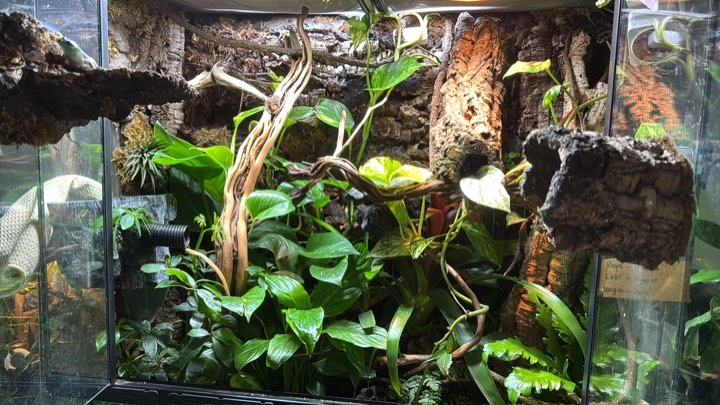
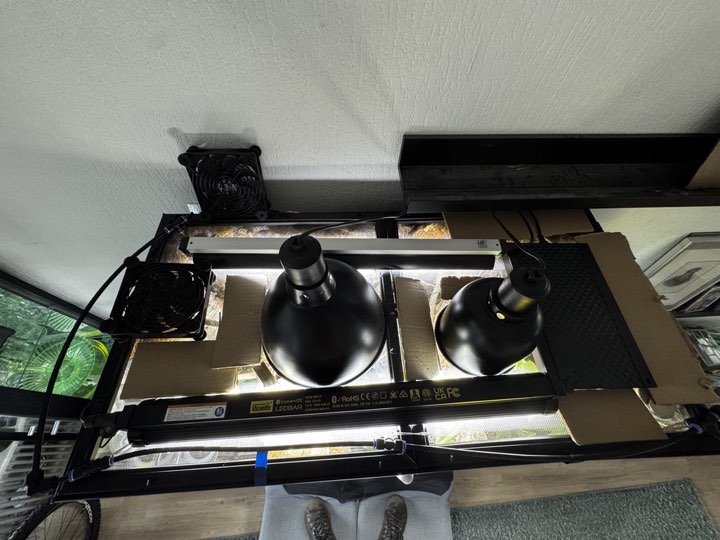
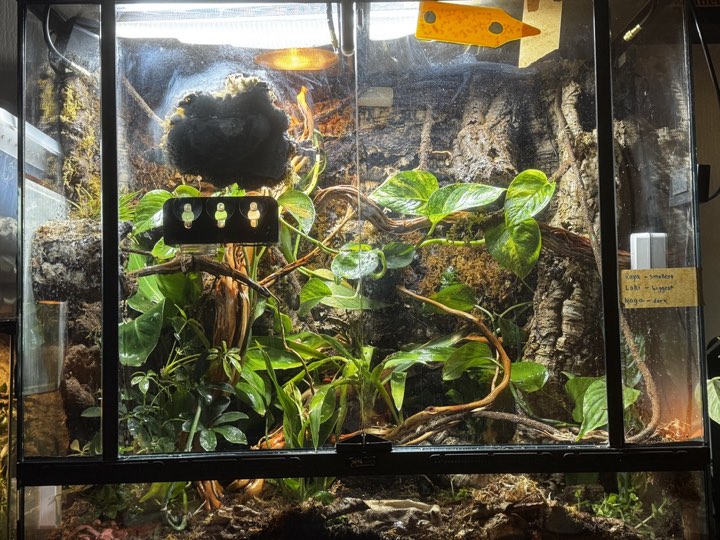
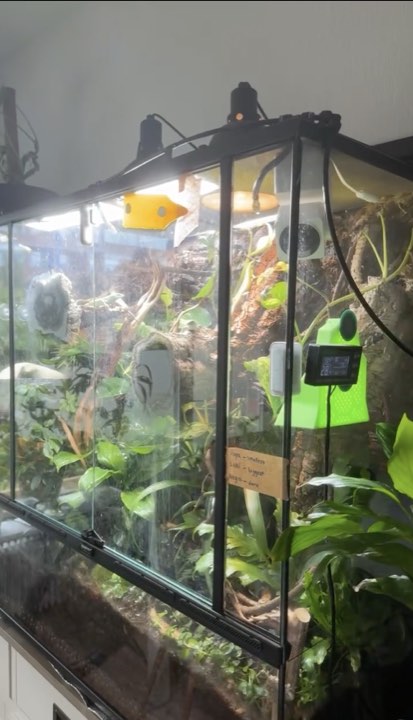
This is my own enclosure and the exact kit running it. Photos and the full parts list are going here, I'm documenting every component and its role, which also feeds the Home Assistant monitoring setup.
Equipment & what each part does
| Component | Role | My specific item |
|---|---|---|
| Enclosure | Tall arboreal space, front-opening, ventilated | Terralantis 90 × 45 × 90 cm |
| UVB lamp | Vitamin D3 synthesis, calcium metabolism | Arcadia T5 HO 6% (Forest) |
| Basking bulb | Focused daytime hot spot | Arcadia 75 W halogen, on the Habistat, timed to the Solomon sun cycle in HA |
| Ambient heat | Background daytime warmth | Reptiradiator 50 W |
| Night heat | Gentle overnight warmth | Arcadia DHP 75 W (summer) · ceramic heater 150 W (winter) |
| Sleep-spot heat | Warm resting spot at night | Large heat pad on the back panel |
| Thermostat | Controls the basking heat safely | Habistat dimming thermostat with the sensor in the middle of the terrarium between the Night heat and basking. |
| Plant / daylight lamp | Bright 6500 K light for plants & activity | Arcadia lumenize jungle dawn led bar with an ESP32-wifi module |
| Misting / fogging | Humidity cycle & drinking droplets | Tuya Wi-Fi mister (Smart Home), run by the HA controller |
| Ventilation fan | Airflow & anti-fungal ventilation | Fan on an IKEA Matter smart plug, run by the HA controller |
| Thermometer / hygrometer | Monitor temperature & humidity | 3× Inkbird ITH-11-B. One per zone (center, center right (ambient) and top of the terrarium) |
| Substrate | Moisture buffer, bioactive base | Bioactive mix: orchid bark, coco fibre, coco coir, play sand & sphagnum moss |
| Live plants | Cover, humidity, climbing surfaces | Pothos, bird's-nest fern, Guzmania 'Tempo' bromeliad, philodendron, creeping fig (Ficus pumila), Peperomia, fittonia, ball moss, peace lily, Tillandsia air plants, Strelitzia nicolai |
| Climbing structure | Cork & branches for vertical living | Cork bark & branches |
| Sensors (Home Assistant) | Automated temp/humidity logging & alerts | Inkbird sensors, spraying, alerts & logging. See page Home assistant |
This is the actual kit running my terrarium. I'll add product links and photos of each part as I go.
Sources & references
Where knowledge of this species actually stands. Lamprolepis smaragdina is still thinly studied. A handful of field papers carry the taxonomy, ecology and natural history, and this site cites them directly wherever it leans on them. Captive husbandry is a different situation: almost all of it rests on the accumulated experience of keepers and breeders rather than on published research, because the research simply has not been done. Every page here is built by comparing sources against each other rather than adopting any single paper, care sheet or keeper as the final word. Published evidence comes first where it exists, care-sheet figures get checked against it, and keeper observation is labelled as keeper observation. As more research appears, some of what is written here will need revising, so read these pages as the best available reading today rather than a settled answer. If you can improve or correct something, please tell me.
- ReptiFiles, Emerald Tree Skink Care Sheet (Mariah Healey). reptifiles.com. Enclosure minimum, basking temperature, the UVI target, lamp-to-branch distances, the Solarmeter recommendation, the 6500 K daylight spec, photoperiod, humidity and substrate depth.
- Krawlo Research Team, Emerald Tree Skink Care Guide. A second set of figures for UVI, humidity and lamp replacement, shown alongside the ReptiFiles values wherever the two differ.
- Clint's Reptiles, Emerald Tree Skink Review. Basking temperature and the case for dedicated UVB.
- Lester, K. (2026). Emerald Tree Skink Care Guide, 1st edition. Community compilation of the husbandry sources for this species. Source for the mesh-top burn mechanism, the deep heat projector point and the bioactive run-in.
- Light My Reptile (Nathan Burton). lightmyreptile.com. Free enclosure lighting simulator, used for the layout planning section above. Beta v0.4.0.
- Open-Meteo archive API (ERA5 reanalysis). open-meteo.com. Day length and relative humidity for the four range localities, 2020 to 2024. Weather data by Open-Meteo.com, CC-BY 4.0.