Handling & Training
They want your company far more than most lizards do. The catch is that contact happens on their terms: they come to you, not the other way round.
Let me clear up the biggest misconception about this species. Emerald tree skinks are not aloof animals that merely put up with you. They actively want human contact, and a lot of it, which is a large part of what makes them such good animals to keep. Mine come to the front of the glass when I walk up, climb onto my hand and arm, and will happily sit there while I potter about.
The one rule that matters: they decide, not you. If a skink wants contact it will walk or jump straight onto you. What does not work is reaching in and lifting one out of the terrarium. Accept that and you get one of the most interactive lizards in the hobby. Ignore it and you get a fast animal that avoids your hands.
Start young
The single biggest factor is starting with a captive-bred baby and building a routine before bad habits (bolting, hiding) set in. A young skink that learns early that you're predictable and safe grows into a settled adult. This is exactly why I raise my babies with gentle, low-pressure exposure before they go home.
They have a social window
One keeper who has bred this species for close to a decade describes a daily rhythm worth knowing about: his animals sought interaction roughly between 10:00 and mid-afternoon, and outside that window they were simply uninterested, though still happy to eat. That lines up neatly with the wild foraging peak of about 09:00 to 14:00 recorded on Siquijor, so if a skink ignores you in the evening, nothing is wrong.
The same keeper makes a point I think is important: their interest in people is not just food-seeking. His animals asked to come out just as enthusiastically when they were too full to take another insect. Sessions ran about 15 to 30 minutes before they wanted to go back, and warming the room or adding a basking spot outside the enclosure did not extend that, which argues against it being purely about temperature. He also suspected they told individual people apart.
Source: long-term keeper and breeder observations shared publicly by u/RobHerpTX. Anecdotal, but from roughly a decade with the species and consistent with what I see in mine.
The trust-building ladder
Work up one rung at a time. Don't rush to the next until the current one is calm and boring for the skink.
- Settle first (≈2 weeks). Leave a new arrival completely alone to eat, drink and explore. No handling. Just keep the environment right and let it decide the room is safe.
- Be a calm presence. Sit near the enclosure daily. Move slowly. Let it get used to you existing without anything bad happening.
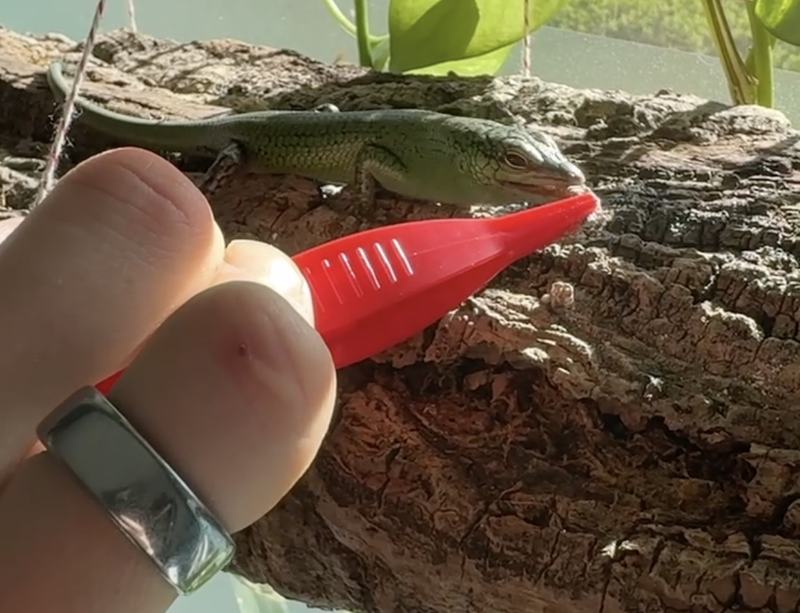
- Introduce yourself with food. Offer insects on soft-tipped tongs, or hold the food dish. Food is how you become "the good thing that appears."
- Hand near, then hand in. Once it feeds from tongs reliably, rest a still hand in the enclosure. No grabbing. Let curiosity do the work.
- Invite it out. When it's bold with the tongs, use them as a gentle bribe to coax it onto your arm, on its terms, for a few seconds at first.
- Short, positive sessions. End before it gets stressed. Always leave the experience calm so the next one starts from trust.
Time out of the terrarium
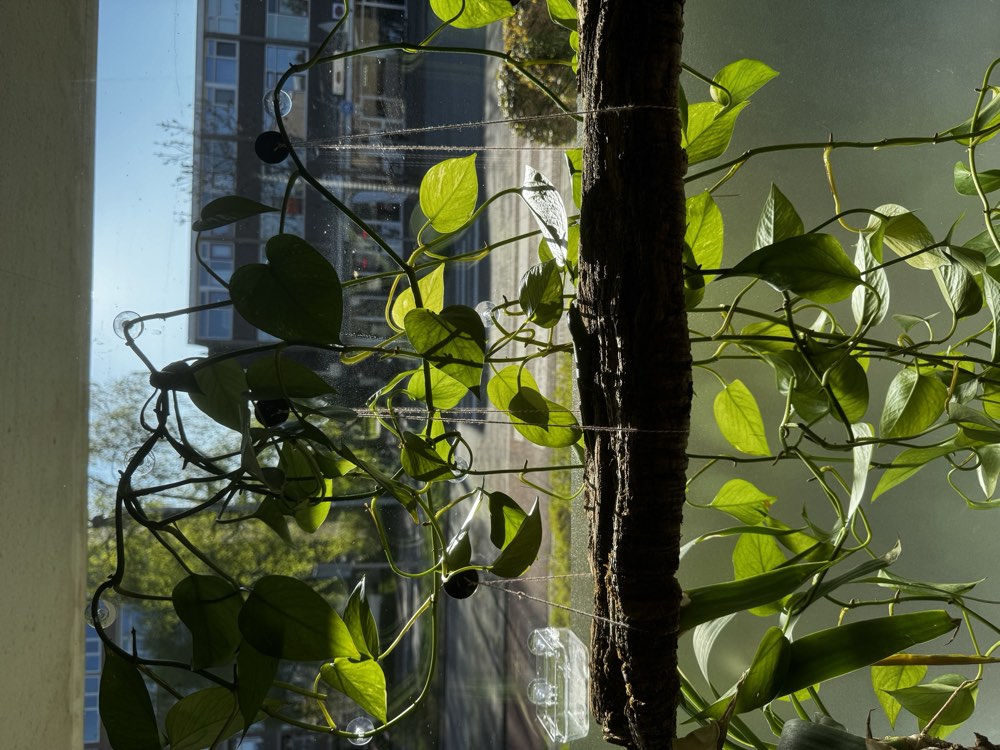
Once mine are confident, I let them out into a planted spot on a sunny windowsill. It's real daylight through the glass, so there's no UVB in it, a bonus, never a replacement for the lamp. What it gives them is a change of scene: somewhere new to climb and explore, a bit of warmth on their backs, and low-pressure time near me. Half the trust I've built came from sessions like this, not from picking them up.
How to pick one up, if you really must
Day to day you should not need this, because a settled skink comes to you. But vet trips, escapes and enclosure moves happen, so when you do have to lift one, do it like this and keep the damage to your trust as small as possible.
- Never from above. A shadow or hand coming down reads as a bird of prey, it'll bolt or drop its tail. Approach low and from the side.
- Scoop from below and support as much of the body as you can. Don't pinch or restrain, they hate being held tight.
- Never grab the tail. It will drop it (see tail autotomy), and it grows back shorter and duller.
- Let go early. If it's squirming hard, calmly set it down. Winning the wrestling match loses the trust.
They're social: with each other
Remember these are social animals that do best in a group. A lot of the "coming out" confidence comes from a settled, well-planted enclosure with company and secure sightlines, a skink that feels safe in its home is far more willing to engage with you.
Some of the field detail on this page was surfaced by the community-written Consolidated Emerald Tree Skink Care Guide compiled by u/RutabagaNo9655 on r/EmeraldTreeSkinks, with keeper observations contributed by u/RobHerpTX. Credit to them for pulling it together. I have gone back to the original papers and cite those directly.
Taming guidance drawn from keeper consensus and community care sheets (ReptiFiles, The Bio Dude, Telos Exotics) plus my own experience raising babies. Every animal is an individual.