Husbandry & Diet
Warm, humid, well-fed and left to climb, get these right and the rest follows.
This is the day-to-day of keeping these skinks: what I feed mine, how often, what I dust it with, and how I keep them hydrated and happy. The enclosure side of things, the plants, UVB and heating, all lives on the terrarium page.
Quick care summary
| Diet | Insectivore-leaning omnivore |
|---|---|
| Feeding (adult) | Every 1–2 days |
| Feeding (juvenile) | Daily |
| Daytime temp | 26–30 °C ambient |
| Basking spot | 32–35 °C |
| Night temp | 24–25 °C (mild drop) |
| Humidity | 70–85% by day, rising to 85–99% overnight |
| UVB | Required. UVI 2.0–2.5 at the branch, see terrarium page |
| Handling | As much as they want, let them come to you, do not grab them |
| Social | Yes: keep two or more, never alone! |
Diet
In the wild this skink is mainly an insect hunter that also takes soft fruit and nectar. A good captive diet mirrors that: a rotating base of feeder insects, plus occasional fruit and, for some keepers, a little prepared diet.
Staple feeder insects
- Crickets, a reliable staple; active prey triggers the hunt response.
- Dubia roaches, nutritious, low-fat, easy to gut-load.
- Black soldier fly larvae (BSFL / "calci-worms"), naturally high in calcium.
- Locusts / grasshoppers, good size range for adults.
Occasional / treat feeders
- Waxworms, butterworms, fatty; treats only, not staples.
- Silkworms, hornworms, good variety, well hydrated.
- Mealworms / superworms, hard chitin; use sparingly for adults.
Plant matter & extras
- Small amounts of mashed soft fruit, mango, papaya, banana, berries.
- Repashy-style meal-replacement / fruit gels are accepted by some individuals and add variety.
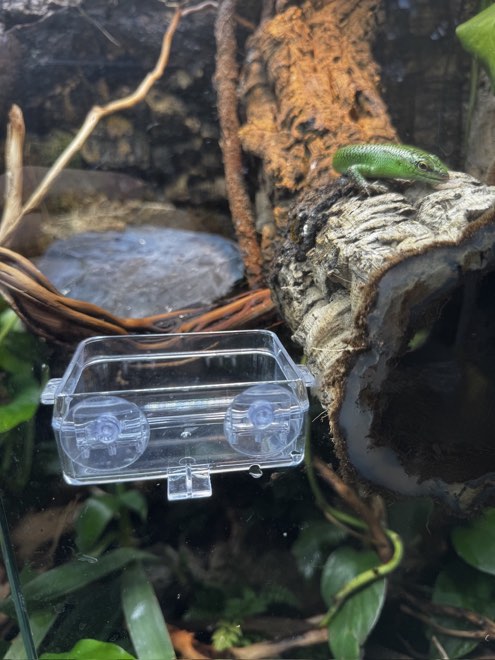
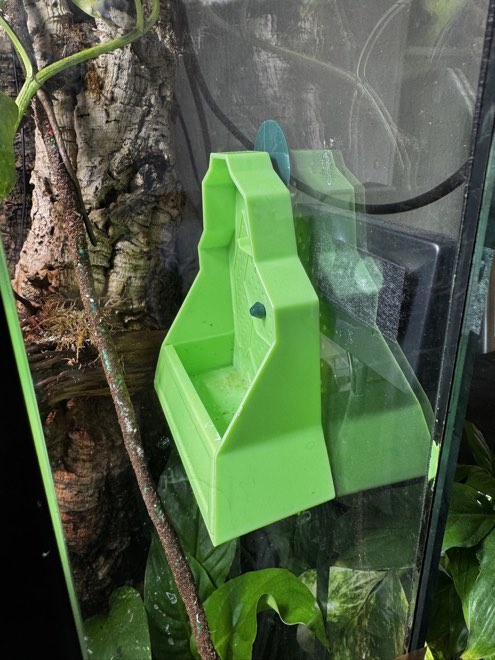
- Offer fruit in a shallow raised dish; expect it to be hit-or-miss between animals.
A gut-load mix worth making
This dry mix comes from Shawn, a fellow keeper, and it is a good example of a balanced home-made gut-load rather than a one-ingredient dusting. Blend it dry, keep it in a sealed tub, and feed it to your insects for a day or two before the insects themselves get fed out.
| Ingredient | Amount | What it is there for |
|---|---|---|
| Rolled oats (havervlokken) | 800 g | The carbohydrate base |
| Fish flakes or dog kibble (visvlokken / hondenbrokken) | 200 g | Protein |
| Wheat bran (tarwezemelen) | 100 g | Fibre. Shawn uses Brinta |
| Brewer's yeast (biergist) | 50 g | B vitamins, and it gets the insects eating |
| Bee pollen (bijenpollen) | 50 g | Extra micronutrients |
| Calcium carbonate powder, without D3 (calciumcarbonaat) | 25 g | Raises the calcium the insects carry |
Recipe shared by Shawn, a fellow emerald tree skink keeper. Credit to him. Quantities make roughly 1.2 kg of dry mix.
Note the calcium carbonate is specified without D3, which fits the low-D3 approach above: the calcium load goes up while the D3 stays with the UVB lamp where it belongs. Gut-loading does not replace dusting, since even a well-fed insect is not a complete meal on its own.
Prey size rule
Never offer prey wider than the space between the skink's eyes. Oversized feeders are a choking and impaction risk, especially for juveniles.
Supplementation
Supplements go on the feeders ("dusting") right before you offer them. A typical rotation:
| Supplement | How often | Notes |
|---|---|---|
| Calcium without D3 | Most feedings | Light dusting; the workhorse supplement |
| Calcium with D3 | 1–2× / week | Skip or reduce if UVB is strong; avoid double-dosing D3 |
| Multivitamin | ~1× / week | Provides vitamin A and trace nutrients |
Two schools on vitamin D3
Worth flagging as an open question rather than settled practice. The schedule above gives calcium without D3 at most feedings and holds calcium with D3 back to once or twice a week. That is what I do, and the Krawlo care guide reaches the same conclusion: where UVB is doing its job, keep dietary D3 low and reserve calcium with D3 for animals that are not getting adequate UVB.
ReptiFiles takes a different line, recommending an all-in-one supplement containing calcium, vitamins and a low level of D3 at every feeding alongside proper UVB (source: reptifiles.com care sheet). Plenty of keepers run that way successfully.
Both camps agree on the part that matters: UVB is not optional, and dietary D3 never replaces it. No published research settles a schedule for this species, so there are genuinely two defensible approaches here. What keeps me and Krawlo on the low-D3 route is that an excess of D3 is harder to correct than a shortfall.
Hydration & humidity
Emerald tree skinks rarely drink from a standing bowl, like many arboreal reptiles they lap water droplets off leaves and décor. So how you deliver water matters as much as having it available.
- Mist the enclosure 1–2× daily; morning and evening works well. Droplets on foliage are the main drinking source.
- Humidity runs as a daily cycle, not a flat number. Aim for 70–85% through the day and let it rise to 85–99% overnight, which is what the native range actually does. A dip toward 60% once the enclosure has dried is the normal other half of that cycle, not a fault. What you are avoiding is a permanent swamp. The terrarium page has the measured range data behind these figures.
- Consider an automatic mister on a timer for consistency (see terrarium tech). I would not add a fogger as routine kit, for the reasons set out on that page.
- A small water dish adds ambient humidity even if it's rarely drunk from; keep it clean.
- Good ventilation is essential: stagnant, over-wet air causes respiratory infections and mould.
Feeding routine
- Feed during the day when the animal is warm and active, it won't hunt effectively when cold.
- Offer live prey by hand-feeding tongs, in a dish, or loose in the enclosure; loose insects encourage natural foraging but remove uneaten crickets (they can nibble a sleeping skink).
- Watch body condition: a healthy skink has a firm, rounded body and a full-but-not-bloated belly, with no visible hip bones or sunken flanks.
Handling & temperament
These skinks actively want human contact, and plenty of it, which is a large part of what makes them such good animals to keep. Mine come to the front of the glass when I walk up and climb onto my hand of their own accord. The rule that matters is that they decide, not you. Contact happens when the skink offers it, and reaching in to lift one out does not work.
- Let them come to you. A settled skink will walk or jump straight onto your hand or arm. Grabbing one costs you trust you spent weeks building.
- Character varies a lot. Some keepers describe theirs as wanting to cuddle. Others stay more reserved and prefer to interact from a nearby branch. Both are normal.
- Wild-caught adults are typically the most flighty; captive-bred youngsters raised with gentle, low-pressure exposure settle far better.
- Never grab or restrain by the tail, autotomy (tail drop) is likely.
- When you genuinely have to lift one, for a vet trip or an enclosure move, approach low and from the side and scoop from below. Never from above, which reads as a bird of prey.
Full detail, including the trust-building ladder and their daily social window, is on the handling and training page.
Never alone: keep two or more
Emerald tree skinks are social animals and should never be kept singly. Keep them as a pair or a small group in a large, richly planted enclosure with plenty of height, several basking spots and broken sightlines so every animal has its own space. A well-matched group settles faster and behaves far more naturally than a lone skink.
The answer to tension is more space and structure, not isolation. Multiple males can spar, so watch a new group as it settles and make sure each animal is feeding, holding weight and has retreats of its own, add cover, height and sightline breaks rather than separating an animal off on its own.
Sources & references
- ReptiFiles, Emerald Tree Skink Care Sheet (Mariah Healey). reptifiles.com. Gut-loading interval, the all-in-one low-D3 supplement position, and the fogger guidance.
- Krawlo Research Team, Emerald Tree Skink Care Guide. The calcium-without-D3 position where UVB is provided, which is the approach followed here.
- Lester, K. (2026). Emerald Tree Skink Care Guide, 1st edition. Community compilation of the husbandry sources; where the two supplementation approaches were set out side by side.
- Shawn, fellow emerald tree skink keeper. The gut-load recipe.
- Temperature and humidity targets are sourced in full on the terrarium page.