Subspecies & Colour Forms
Lamprolepis smaragdina is spread across an enormous, broken-up island range, populations have drifted apart in colour and patterns.Historically several subspecies were named, and the trade uses a looser set of "locality" or "form" labels based on how animals look and where they were collected.
Nearly all of this page is A. Z. Andis Arietta's work
In March 2026 he published More Than Morphs: Geography, Lineages, and Trade in Emerald Tree Skinks at Holotypica. He phenotyped 720 research-grade iNaturalist observations, mapped the results against geography, read them against the published phylogenies, and cross-checked them against nine years of wildlife trade records. Nobody else has done that for this species. The six-morph scheme, the hindlimb diagnostic, the maps, the illustrations and the trade analysis below are all his.
His article is the detailed read, and I would send you there before here. He has the full argument, the figures at full size, and the data and code published openly so you can check the whole thing yourself.
What follows below is my own interpretation of his findings set alongside the other sources on this page, written for keepers and kept here so the care side of this site holds together in one place. Where a claim is his, I say so and cite him inline. Where I have written additional information, that is mine.
His work is cited on this page as: Arietta, AZA. (2026). More Than Morphs: Geography, Lineages, and Trade in Emerald Tree Skinks (Lamprolepis smaragdina). holotypica.com/more-than-morphs-emerald-tree-skinks/
Biogeographic history
Lamprolepis smaragdina is spread across Southeast Asia, Oceania and the western Pacific archipelagos, and in places it reaches extraordinary density. On some islands this one skink makes up the largest share of the vertebrate biomass.
Three separate processes pulled those populations apart. Tectonic and volcanic geology split them as the archipelagos formed, which is vicariant divergence. Storms and currents then rafted individuals across ocean gaps, a process with the wonderfully honest name of waif dispersal, or sheer luck. On top of that, people moved them: the Mariana Islands population, and probably Guam, arrived during military operations (Hileman et al. 2020, via Arietta 2026).
How the species got its name
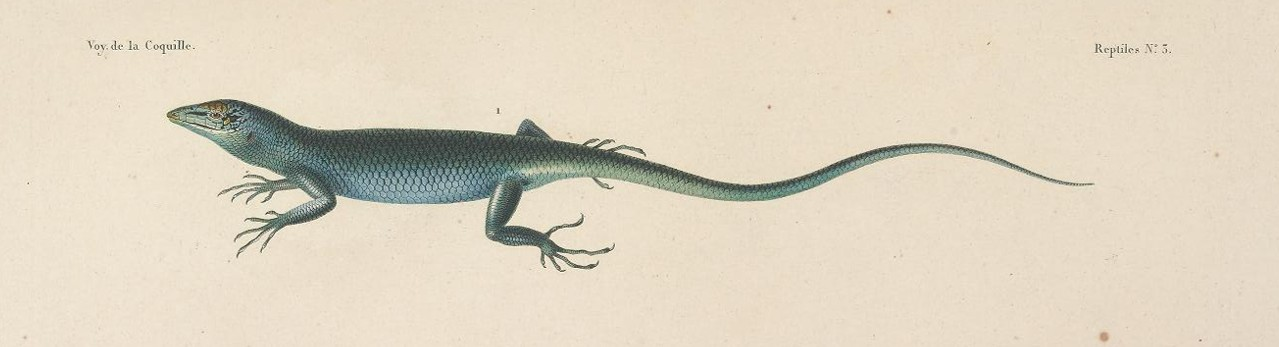
René Primevère Lesson described the species in 1826, during a round-the-world voyage aboard the corvette La Coquille. His illustrations came before the formal written description, which is why the plate above rather than a preserved specimen is regarded as the holotype, with some historical ambiguity attached. The name then moved around for a century and a half. The species was shuffled through the genera Scincus, Lygosoma and Dasia before Greer settled it as Lamprolepis smaragdina in 1970 (source: Arietta 2026).
The eight described subspecies
As explorers and researchers tried to impose a naming structure on scattered island populations, as many as eight subspecies were described: acutirostre, elberti, moluccarum, perviridis, philippinica, pisangense, smaragdina and viridipuncta (source: Arietta 2026).
Only philippinica is still used today, and mostly out of convenience. Most researchers accept that L. smaragdina is a far more complicated mixture of distinct populations and phenotypes than the old subspecies names can capture (source: Arietta 2026). That is the honest starting point for everything below: the labels are a convenience, and the biology underneath them is messier and more interesting.
One thing is worth being plain about, because these names still get passed around as though they were settled: none of the eight was ever established genetically. Every one was erected from appearance and locality, most of them long before anyone could sequence a lizard. The molecular work that followed did not set out to confirm or retire them either. Linkem et al. (2013) recovered six mitochondrial clades, and those clades are discussed against phenotype and geography rather than against the old subspecies names, while Reiley et al. (2025) looked at population structure in the Lesser Sundas rather than at taxonomy (source: Arietta 2026). Six of the eight are in fact still carried as accepted subspecies by the Reptile Database, acutirostre, moluccarum, perviridis, philippinica, smaragdina and viridipuncta, with elberti and pisangense moved into synonymy. In day to day use, though, philippinica is the only one anyone reaches for, and all six rest on museum morphology rather than on a genetic test. The clades and the morphs are the real structure here. The subspecies names are historical residue sitting on top of them.
What the morphs actually are
Arietta downloaded all 1060 research-grade iNaturalist observations of the species, randomised the images, and systematically phenotyped every one that showed enough of the animal clearly enough to score, which left 720. After grouping and regrouping, he settled on six phenotypes he could classify reliably: 50-50, saddleback, all-green, brown, black-spotted and hypermelanistic. He grouped them primarily on dorsal pattern and hindlimb colour, and of those two the hindlimbs are the character that separates the morphs most reliably (source: Arietta 2026).
| Morph | Hindlimbs | Description |
|---|---|---|
| 50-50 | Always brown, usually with white or salt-and-pepper mottling | Green front half, bronze or brown back half. Salt-and-pepper spotting usually sits on the posterior dorsum along with the brown, and can run forward over the green. Forelimbs either brown with mottling or green. This is the morph consistent with the philippinica subspecies. |
| saddleback | Always brown, usually mottled | Green tail, and often less brown overall than the 50-50. The brown wraps around the back of the body where the hindlimbs join, leaving the green base colour present both in front of it and behind it, hence the saddle. |
| all-green | Always brown, usually with white or salt-and-pepper mottling | Body and tail entirely green. Forelimbs either brown with mottling or green. The salt-and-pepper dorsal patterning of the 50-50 and saddleback is sometimes present in reduced form, but usually absent. This is the standard green animal in the hobby. |
| brown | Always brown, usually mottled | The brown pattern of the 50-50 and saddleback extended over the whole body, with salt-and-pepper spotting that varies from faint to pronounced. |
| black-spotted | Green based, with or without black spotting or mottling | Green base colour much like the all-green, but the hindlimbs are green rather than brown. Black spotting can appear on both the back and the limbs, and is sometimes reduced almost to nothing. |
| hypermelanistic | Green based, similar to black-spotted but darker | Mostly uniform dark yellow-brown across the body. Unlike the brown morph, the salt-and-pepper spotting is absent and the base colour is darker, with a yellow-green tone rather than light brown. Effectively a darker black-spotted. |
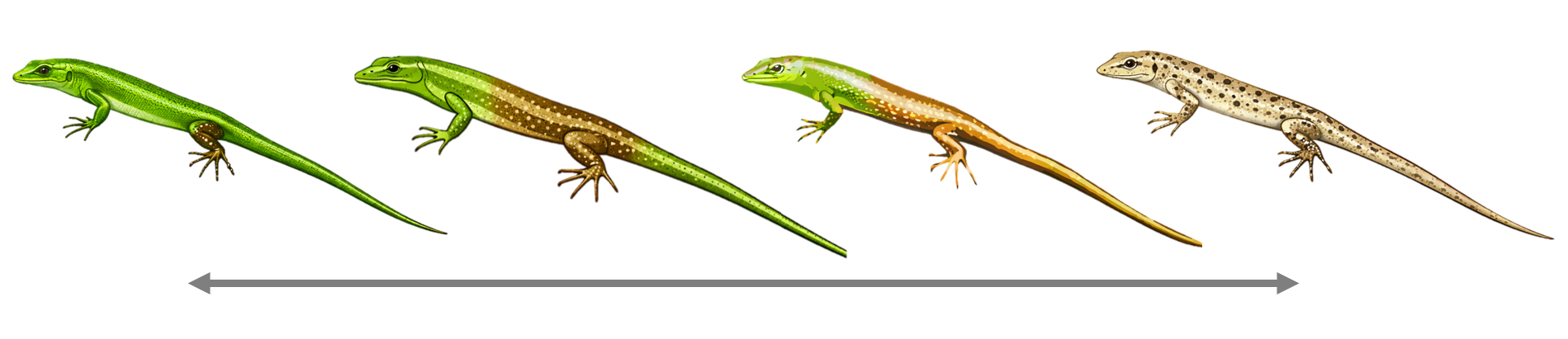
So the hindlimbs are the diagnostic character, and they are what tells the black-spotted morph apart from the all-green. All-green, saddleback, 50-50 and brown all have brown hindlimbs with white spots, and Arietta reads those four as close to a continuum: one brown pattern originating at the hindlimbs and spreading over more and more of the body. The black-spotted morph always has a green base to the hindlimbs, which may or may not carry black spotting. The hypermelanistic morph is essentially a darker version of the black-spotted, with similar but darker hindlimbs (source: Arietta 2026).
If you keep this species, that is the practical takeaway. Look at the back legs, not the back.
The two morphs you will actually meet in captivity
Of the six, only two have reached European and American collections in any number, and the pair of photographs below happen to show the hindlimb diagnostic rather neatly.
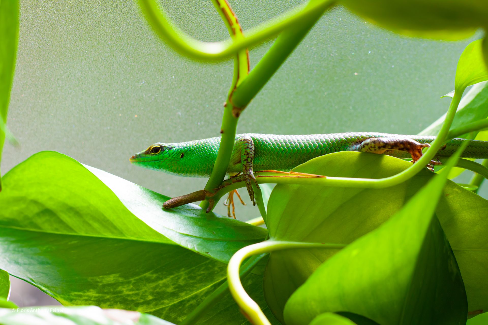
all-green, the common one
Green from nose to tail tip, with little or no dark patterning, and a brown mottled hindlimb which you can see against the leaf in this photo. On Arietta's reading these trace to the Solomon Islands, which supplied 98% of the animals recorded entering the US trade. This is one of mine. © Floris Anthony Feiner
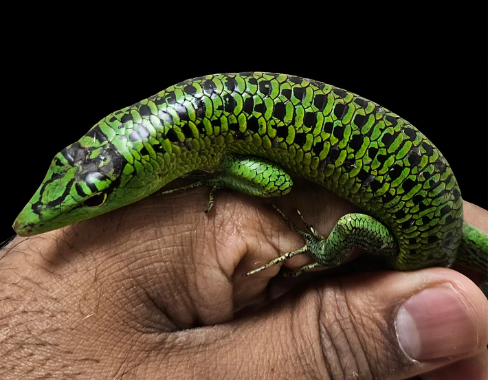
black-spotted, the other one
Green base with heavy black spotting over the back and head, and, critically, a green hindlimb rather than a brown one. Arietta places these with Indonesian exports, most plausibly Sulawesi. Image from New Empire Dragons.
Those two are not simply a light and a dark version of the same thing. They sit on opposite sides of the hindlimb split, which is the character Arietta found most reliable for telling the morphs apart, so keeping them as separate lines is the cautious choice (source: Arietta 2026). The genetics turn out messier than the hindlimbs alone would suggest, and I come back to that below.
The morphs follow geography
All of the phenotyping was done blind to location, and the coordinates were only added afterwards. If the species were simply highly polymorphic, the morphs would scatter more or less at random across the range. They do not (source: Arietta 2026).
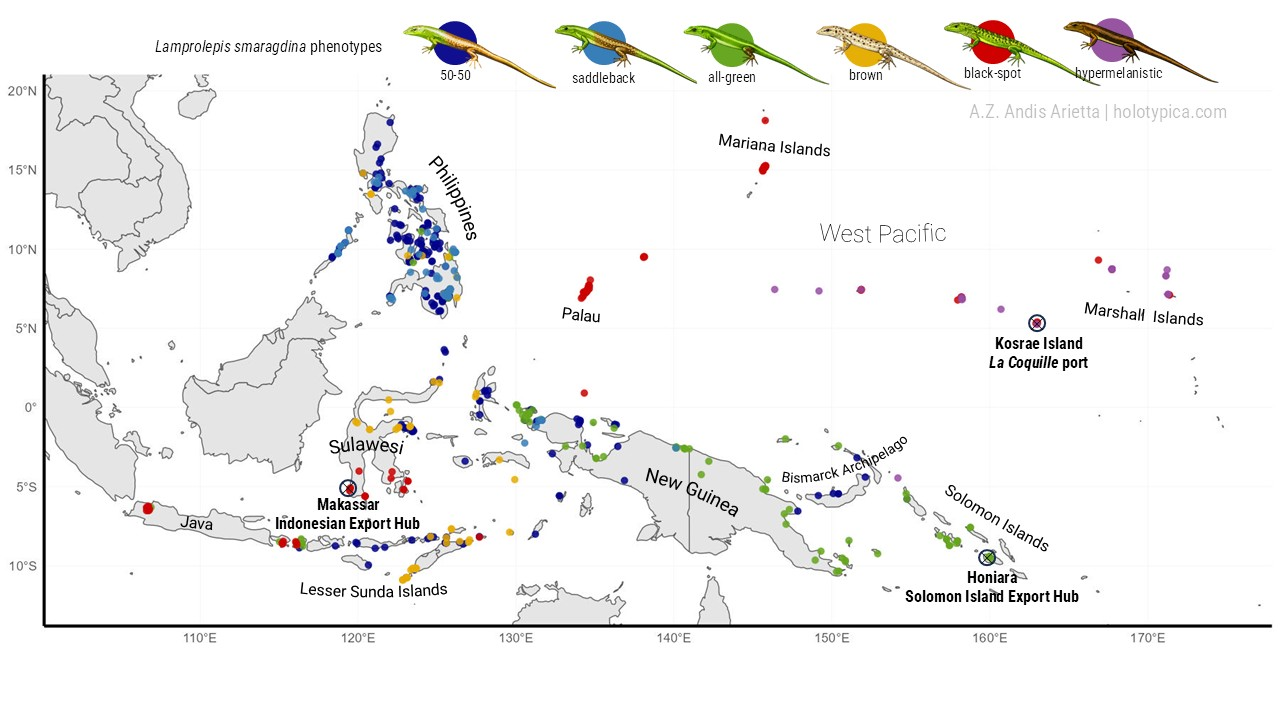
The sharpest patterns are in the Philippines, the Solomon Islands and Sulawesi. Only brown-hindlimb morphs occur in the Philippines. Only green-hindlimb morphs occur on the west Pacific islands (source: Arietta 2026).
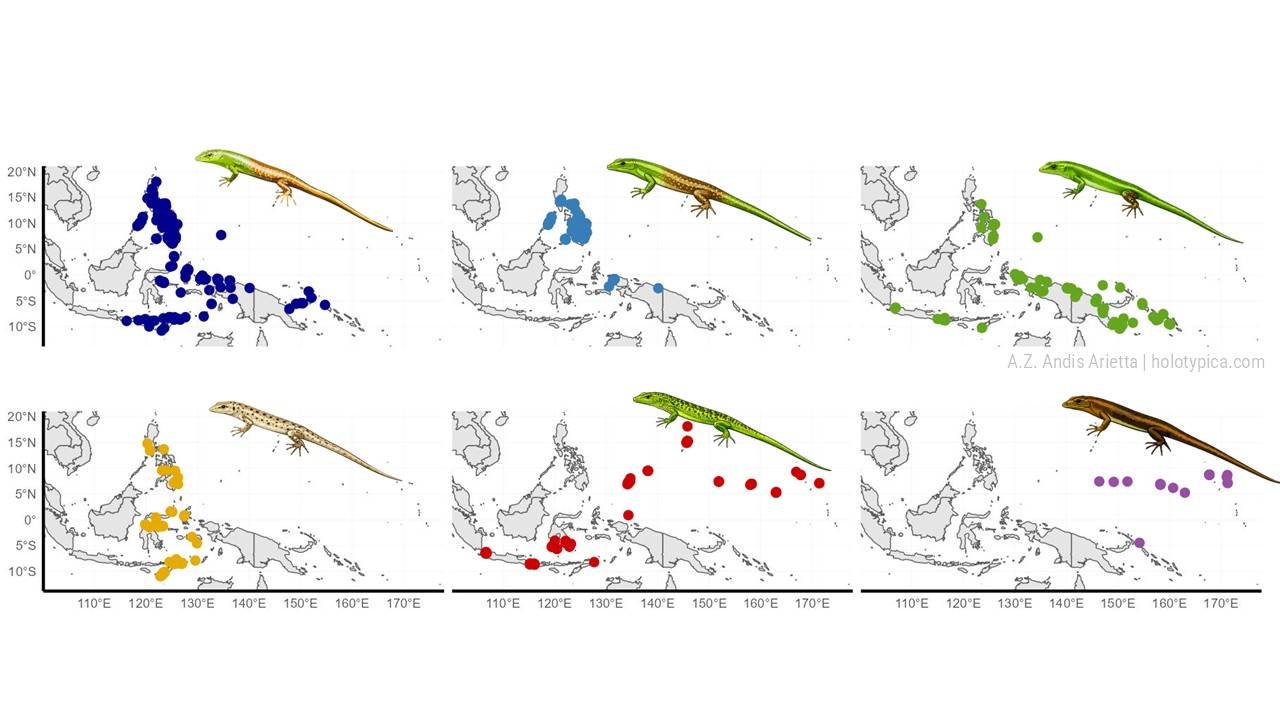
Morph by morph, this is how the ranges fall (source: Arietta 2026):
- all-green, the hobby animal, turns up in the Philippines, across New Guinea, the Bismarck Archipelago, the Lesser Sunda Islands, and very heavily in the Solomon Islands. Not on Sulawesi.
- 50-50, the typical philippinica type, is common in the Philippines and the Lesser Sundas, with occasional records from western New Guinea and the Bismarck Archipelago. Absent from Sulawesi and the Solomons.
- saddleback is almost entirely confined to the Philippines, and is likewise absent from Sulawesi and the Solomons.
- brown sits in the western part of the range: the Philippines, the eastern Sunda Arc, and the northern half of Sulawesi.
- black-spotted is found heavily on both southern peninsulas of Sulawesi and in the Lesser Sundas, and is most strongly associated with the scattered small islands of Micronesia, from Palau north to Guam and the Marianas and east to the Marshall Islands.
- hypermelanistic overlaps almost entirely with black-spotted in the southern Micronesian islands.
Two of those deserve pulling out. The Solomon Islands carry only the all-green morph, with a single odd exception in the dataset. And Sulawesi is split down the middle: the northern half holds the brown morph, the southern half holds the black-spotted, each confined to its own half (source: Arietta 2026).
What Lesson actually drew
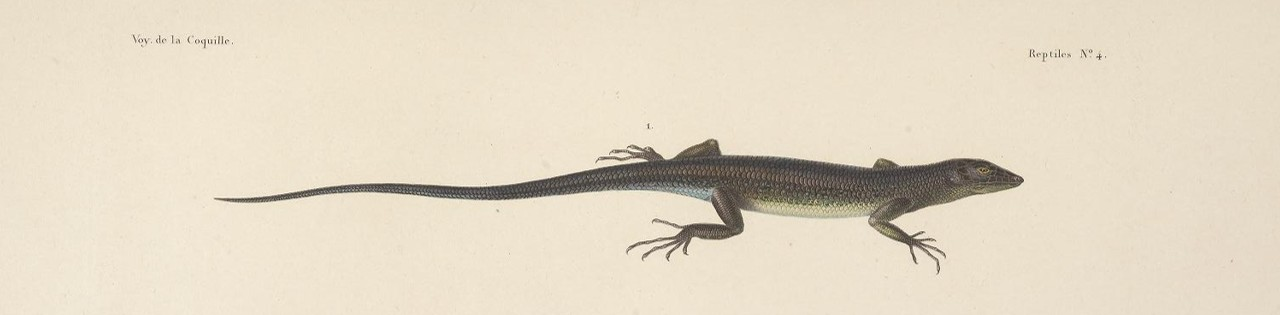
Lesson originally described two forms, smaragdina and viridipunctus, and the plates are the holotypes for both. Arietta's reading of them is that neither matches the animal most keepers have (source: Arietta 2026).
Lesson's smaragdina, from the Latin for emerald, looks like the black-spotted morph rather than the all-green one: uniform green, green hindlimbs, and possible black mottling around the nares and eyes, with no brown patterning on the back legs. The viridipunctus plate looks like the hypermelanistic morph, and the name, meaning green spotting, fits an animal that reads as uniformly brown with green speckling along the flanks, which is what the plate shows (source: Arietta 2026).
The voyage supports that reading. La Coquille is only documented to have made port at Kosrae in the Caroline Islands, out in the west Pacific, and only the black-spotted and hypermelanistic morphs are found there (source: Arietta 2026). The two sources disagree on the detail here. The Reptile Database gives the type locality as Boston Island, now Ebon Atoll in the Marshall Islands, rather than Kosrae. Both islands sit inside the same green-hindlimb west Pacific zone, so the reading above survives either way, but the exact island is not settled.
The genetics underneath
Phenotype and geography lining up is suggestive on its own. The published genetic work points the same way (source: Arietta 2026).
Linkem et al. (2013) sequenced 204 specimens across most of the range, though without the Solomon Islands, the Lesser Sunda Arc, Java or western New Guinea. Mitochondrial markers gave six clades, and those clades largely recapitulate the boundaries between the phenotypes. The north and south Sulawesi phenotype split corresponds to genetically distinct populations. Multiple distinct populations show up in the Philippines, as sister clades to the south. Clade 6, which resembles the distribution of the all-green morph on New Guinea, falls out as sister to the Philippine clades, which supports reading the brown-hindlimb morphs as a continuum (source: Arietta 2026).
Arietta is careful to flag where the fit is imperfect rather than smoothing it over. The brown morph corresponds to Linkem's Clade 2, which comes out as sister to the black-spotted Sulawesi population rather than to the other brown-hindlimb morphs. And Clade 6 groups populations from Peleng Island, eastern New Guinea, the Bismarck Archipelago, Palau and the Marianas in a way he finds geographically implausible, with the largest branch paraphyletic and a monophyletic Solomon Islands group nested inside two sets of Palauan samples. His read is that Clade 6 is largely an artefact of undersampling western New Guinea, the larger Solomon Islands and the Caroline Islands (source: Arietta 2026).
Reiley et al. (2025) covered the gap, working entirely on the Lesser Sundas. That archipelago matters because it is the only part of the range where brown-hindlimb and green-hindlimb phenotypes substantially overlap, which makes sense given that the dominant currents funnel the rest of the range towards it, and human commerce runs the same way. They found strong divergence between island populations such as Atauro, Wetar, Flores and Lombok, and divergence within islands too, as on Timor (source: Arietta 2026).
Where the hobby animals come from
The last piece is the trade data. Arietta pulled the LEMIS records for every wildlife import and export through US ports between 2014 and 2022 (Marshall et al. 2025) and filtered them to this species (source: Arietta 2026).
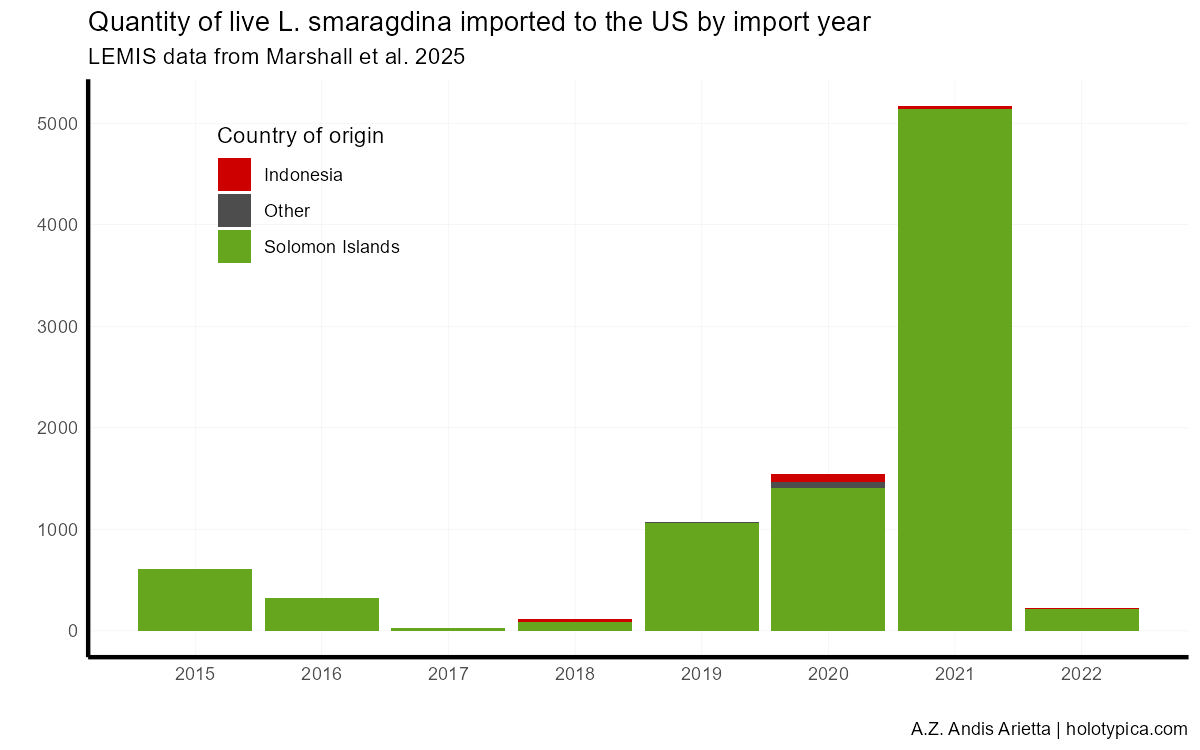
Just under 10,000 emerald tree skinks passed through US ports across those nine years, 9,422 in total, of which 9,087 were animals coming into the US trade. Almost all of them came from two countries: the Solomon Islands at 98%, with Indonesia a distant second at 2%. As far as Arietta has seen, only the all-green and black-spotted morphs are present in US and European captive collections, and all-green dominates by a wide margin (source: Arietta 2026).
Nobody will ever pin an individual import to a precise collection site. Animals get gathered from many locations by independent harvesters, passed to an importer, and then moved to a shipping hub, so the paper trail stops at the country. What you can do is reason from the morph maps, which is what Arietta does (source: Arietta 2026).
The black-spotted morph does not occur in the Solomon Islands at all, so hobby black-spotted animals have to come from Indonesia, most plausibly Sulawesi or the islands next to it. The Sunda Islands and Java are less likely, because the 50-50 morph is far more common there and has not shown up in imports. Running the same logic the other way, the all-green animals in the hobby most likely trace to the Solomon Islands, since all-green is the only morph found there (source: Arietta 2026).
What the surveys actually counted
Two field studies give hard numbers. On Chuuk in Micronesia at least 13 colour morphs have been reported, with about two-thirds of colour-noted animals green (Kepler 1994, in Perry and Buden 1999). Those surveys count differently from Arietta: they sort animals by overall body colour, where he sorts them by dorsal pattern and hindlimb, so a tally of 13 colour morphs and a scheme of six phenotypes are not two answers to the same question. Across the Federated States of Micronesia, 56% of 274 animals were green, the rest brown or intermediate. On Saipan and Tinian, by contrast, all 105 animals recorded were green, and no other colour has ever been reported there.
In the Solomon Islands, the form most often seen in the trade, both bright green and olive green are commonly observed (McCoy 1980). Philippine populations are different again: most are green only on the head and front of the body with a brown rear, but isolated island populations such as Siquijor and Caluya are predominantly green with dark streaking (Bucol et al. 2011).
Perry and Buden read the all-green Mariana populations as a founder effect, a small group arriving once and carrying little genetic variation, which fits their view that this skink is a poor natural disperser. Worth flagging honestly: that reading sits awkwardly beside Linkem et al. (2013), who tested human-mediated dispersal across the wider range and rejected it in favour of natural over-water dispersal. Both can be true in different places, and the question is not settled.
What drives the variation
- Geography: island isolation lets populations diverge, the single biggest factor.
- Individual & age: juveniles and adults can differ, and animals brighten or darken with mood, temperature and health, so a single photo can mislead.
- Sex: differences are subtle and not a reliable way to tell males from females (see breeding).
Don't confuse it with…
Beginners sometimes mix the emerald tree skink up with other green arboreal lizards. It is not a green anole, a day gecko, or the unrelated "green tree skink" names occasionally used for other genera. The combination of a stocky skink body, shining smooth scales, long climbing toes and that grass-green colour is distinctive.
Some of the field detail on this page was surfaced by the community-written Consolidated Emerald Tree Skink Care Guide compiled by u/RutabagaNo9655 on r/EmeraldTreeSkinks, with keeper observations contributed by u/RobHerpTX. Credit to them for pulling it together. I have gone back to the original papers and cite those directly.
Sources & references
- Arietta, A. Z. A. (2026). More Than Morphs: Geography, Lineages, and Trade in Emerald Tree Skinks. Holotypica. The six-morph scheme, the hindlimb diagnostic, the pheno-geography and the trade analysis on this page are his work, used here with thanks and cited as he asks. Figures 9, 10, 11 and the import chart on this page are reproduced from that article with credit, as are his scans of the two Lesson plates.
- Uetz, P. et al. (eds). The Reptile Database. reptile-database.reptarium.cz. Accepted subspecies list and synonymy. Cite as Uetz et al. 2021, Herpetological Review 52: 246 to 255.
- Linkem, C. W., Brown, R. M., Siler, C. D., Evans, B. J., Austin, C. C., Iskandar, D. T., Diesmos, A. C., Supriatna, J., Andayani, N. & McGuire, J. A. (2013). Stochastic faunal exchanges drive diversification in widespread Wallacean and Pacific island lizards. Journal of Biogeography 40(3): 507 to 520. Arietta cites this paper as 2012; the journal issue is dated 2013, which is the year used on this page.
- Perry, G. & Buden, D. W. (1999). Ecology, behavior and color variation of the green tree skink, Lamprolepis smaragdina, in Micronesia. Micronesica 31(2): 263 to 273.
- Bucol, A., Alcala, M. L., Catid, R., Basa, J. E., Sequihod, I., Pagente, A. & Kilat, W. (2011). Notes on the biology of the green tree skink Lamprolepis smaragdina philippinica, Siquijor Island, Philippines. Silliman Journal 52(2).
- McCoy, M. (1980). Reptiles of the Solomon Islands. Wau Ecology Institute Handbook 7, Wau, Papua New Guinea.
- Kepler, A. K. (1994). Chuuk coastal resources inventory, terrestrial surveys, August 1993. Administrative report to CORIAL, Federated States of Micronesia.
- de Rooij, N. (1915). The Reptiles of the Indo-Australian Archipelago I. Lacertilia, Chelonia, Emydosauria. Leiden: E. J. Brill.
- Sternfeld, R. (1918). Zur Tiergeographie Papuasiens und der pazifischen Inselwelt. Abhandlungen der Senckenbergischen Naturforschenden Gesellschaft 36: 375 to 436. Original description of elberti, from Wetar.
- Brongersma, L. D. (1931). Original description of pisangense, now treated as a synonym.
- Peters, W. (1873). Original description of viridifuscum, now treated as a synonym.
- Lesson, R. P. (1826). Reptile plates 3 and 4. In: Atlas de Zoologie, Voyage autour du monde, exécuté par ordre du Roi, sur la Corvette de sa Majesté, La Coquille, pendant les années 1822-1825. Arthus Bertrand, Paris. The two holotype illustrations reproduced on this page. Public domain. Located, scanned and interpreted by Arietta (2026).
- Greer, A. E. (1970). The Relationships of the Skinks Referred to the Genus Dasia. Breviora 348: 1-30. The paper that settled the species in Lamprolepis. Cited via Arietta (2026); I have not read the original.
- Hileman, E. T., Eichelberger, B. A., Liske-Clark, J., Barnhart, P. D., Reed, R. N., Yackel Adams, A. A. & Nafus, M. G. (2020). Landscape dominance of introduced herpetofauna on an oceanic island. Global Ecology and Conservation. Source for the human introduction to the Mariana Islands. Cited via Arietta (2026); I have not read the original.
- Reiley et al. (2025). Population genetic work on the Lesser Sunda L. smaragdina populations, discussed at length by Arietta (2026), who does not give a full citation for it in his reference list. Reported here on his account rather than mine.
- Marshall, B. M., Alamshah, A. L., Cardoso, P., Cassey, P., Chekunov, S., Eskew, E. A., Fukushima, C. S., García-Díaz, P., Gore, M. L., Lockwood, J. L., Rhyne, A. L., Sinclair, J. S., Strine, C. T., Stringham, O. C., Tlusty, M. F., Valdez, J. W., Watters, F. & Hughes, A. C. (2025). The magnitude of legal wildlife trade and implications for species survival. PNAS 122(2): e2410774121. The LEMIS dataset behind the import figures. Filtered for this species and analysed by Arietta (2026).
- Data and code. Arietta publishes the phenotype scores, the filtered LEMIS extract and the figure code openly. The scored iNaturalist records and the analysis scripts are linked from the original article, and the images render in the browser if you open the sheet. Worth a look if you want to check any of this yourself rather than take my word for it.