Behaviours
Each behaviour is tagged by how well it is supported, from published studies down to keeper anecdote, so you can weigh it accordingly.
Peer-reviewed: published study
Field-observed: recorded in the wild
Terrarium-observed: I've seen it in my own animals
Keeper consensus: most keepers report it
Anecdotal: reported but unverified
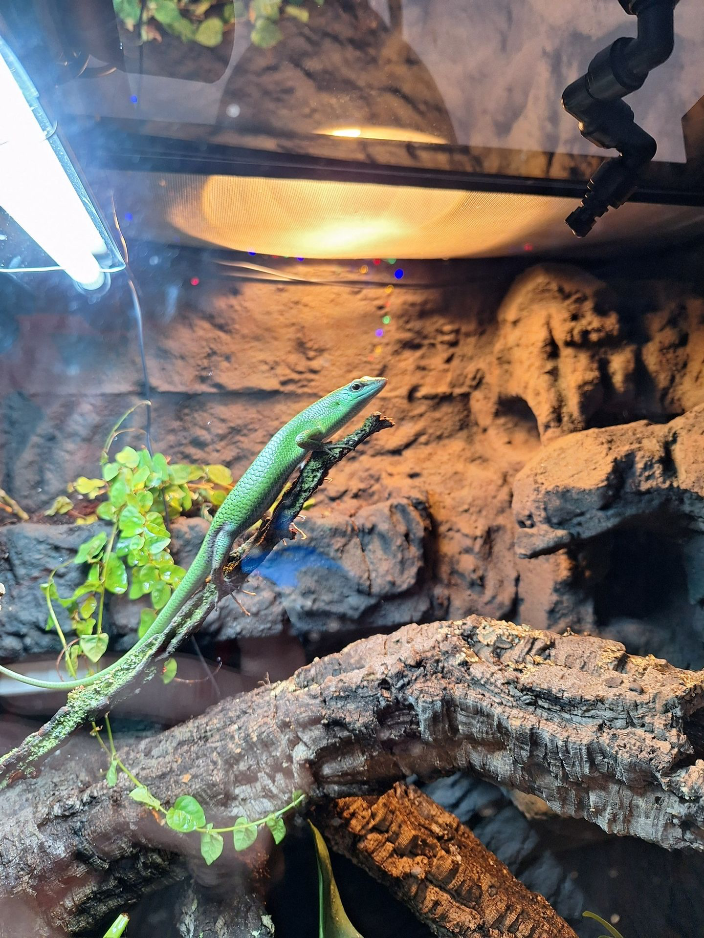
Vertical basking & thermoregulation
Strictly diurnal. Active during the warmer daylight hours, warming on sunlit trunks before hunting, and returning to bask after short showers.
Source: fellow ETS keeper in The Netherlands
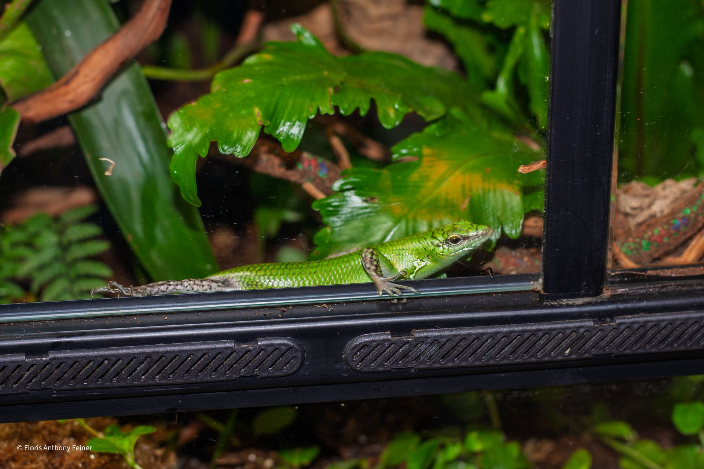
Patrolling the terrarium
As soon as I come towards the terrarium between 12:00 and 17:00 the skinks are patrolling the edge of the doors, desperately wanting to come out.
Source: @Loki
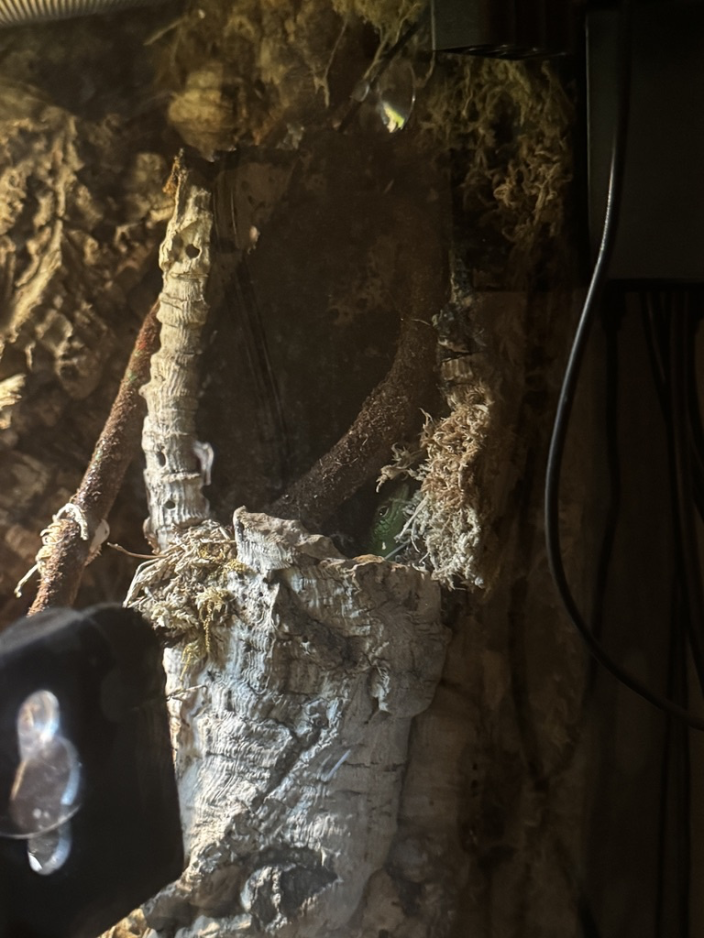
Where they sleep
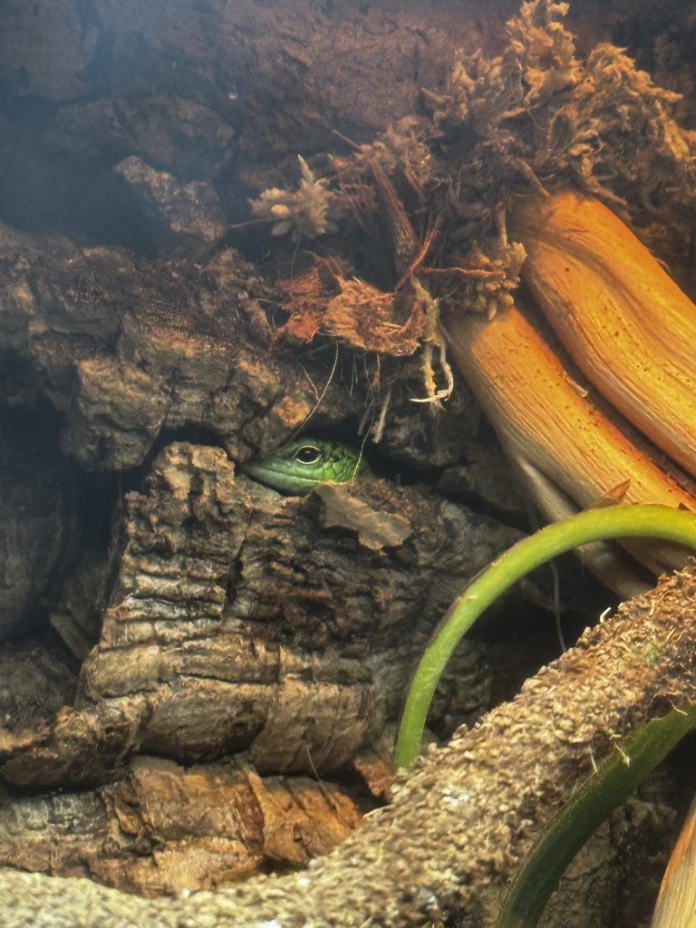
Come lights-out, mine pick the same handful of spots every night wedged into a cork crevice near the warm end, half in a cork round, tucked in tight enough that you'd walk straight past and miss them. There's a heat pad on the back panel right behind that spot that is on in the winter, so it stays nice and.
Source: @Ron
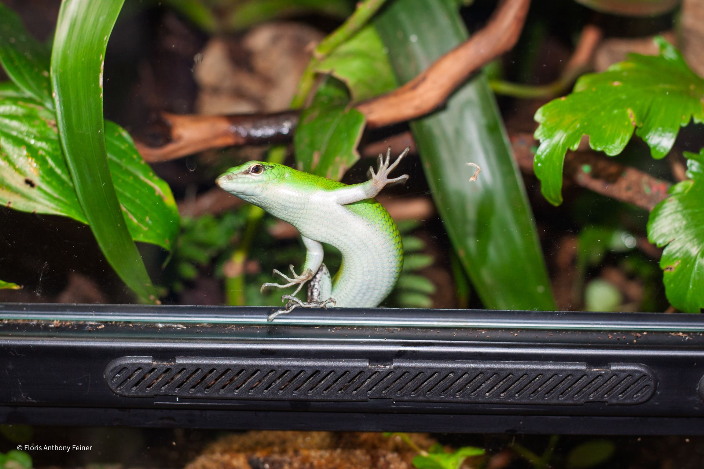
Dancing to come out
When one of mine really wants out, he starts to dance against the glass doors. He's basically asking me to open it. He's figured out that's where he comes out, so that's where he dances. I love seeing it. Means he's settled and wants to explore and see mee.
Source: @Loki
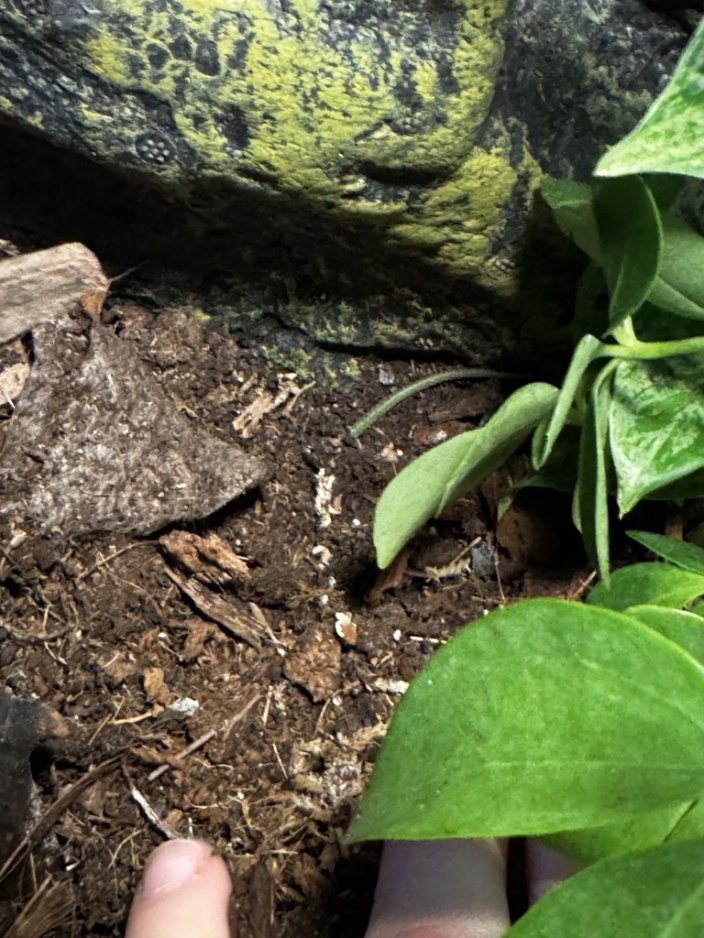
Digging and nosing into the substrate
For a lizard that lives mostly up, mine very rarely (or so I thought) come down and burrow. This is the first time I have ever seen one burrowing. But at some point I was looking in the terrarium and saw that there was an underground tunnel made against the glass. So I checked and saw there were many tunnels in the substrate. So I recommend to keep the substrate deep and loose enough for burrowing but strong enough for making tunnels (hence the chosen mix).
Source: @Naga
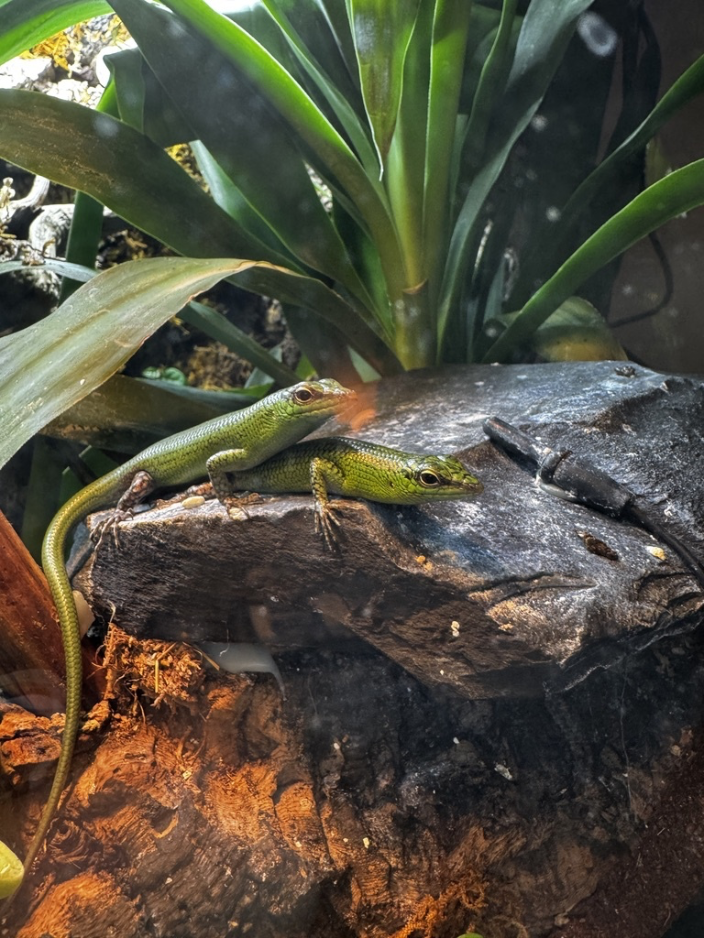
Stacking up to bask
When two of mine want the same warm spot, they don't take turns they pile. One climbs half on top of the other and they both sit there soaking up the heat.
Source: @Ron and @Naga
 © Floris Anthony Feiner
How well they hide
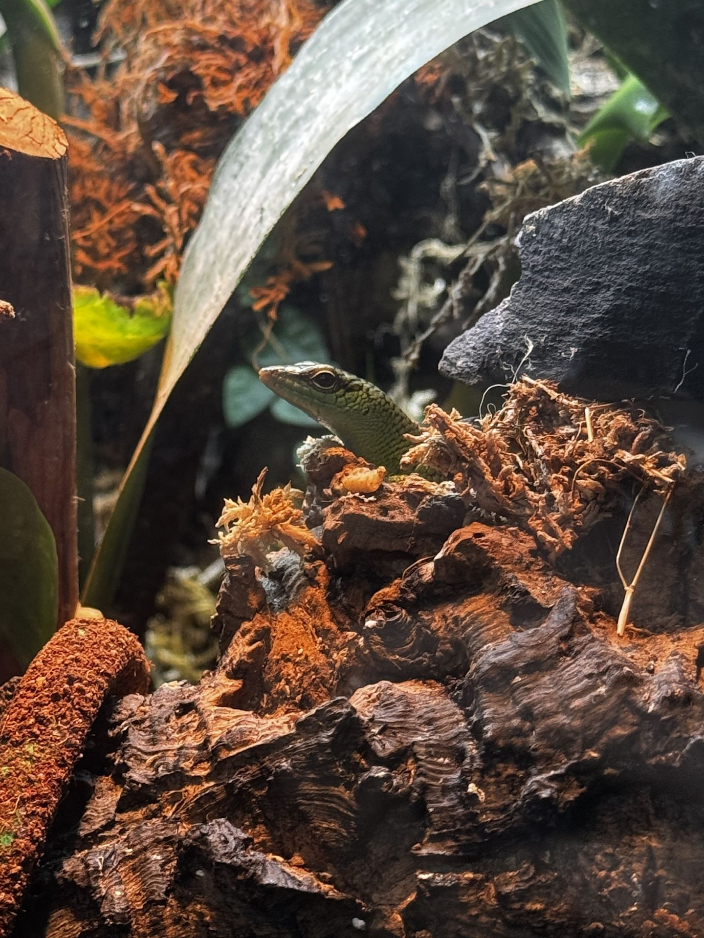
These skinks can disappear! There were so many days that I was sure Loki had got out, the first two times I took the terrarium half apart looking for him, checked the whole room. He'd been tucked into the cork tube acting as a branch going through the terrarium the entire time. I only had to rip a branch out of the cork round to lore him out. If yours goes quiet and you can't find it, don't panic: first check where he might could get into places where they should not go, sit still, wait, and it'll usually surface. A densely planted setup lets them vanish completely, which is just what they want sometimes.
Source: Top photo @Ron and bottom photo @Loki (and one very stressful evening).
What the field surveys recorded
Micronesian surveys found animals typically perched 1 to 5 m up on tree trunks in open, sun-exposed spots, most often on mid-level perches rather than at ground level or in the very top. Around 70% were oriented facing down the trunk, which is worth copying in a vivarium: broad vertical surfaces let them sit head-down and watch. Perches averaged roughly 30 to 37 cm in diameter, so these are animals of thick trunks and large branches rather than twigs, and up to seven were found on a single tree, with larger trees holding more (Perry and Buden 1999).
They sit almost entirely in the lowlands, being scarce or absent above about 200 m.
Social interactions recorded in the wild were courtship and short chases, usually a larger animal approaching and displacing a smaller resting one. The researchers could not determine whether this was about territory, resources or hierarchy, and interactions with other species were rarely seen (Perry and Buden 1999).
Sources & references
- Bucol, A. A., Alcala, M. L. R., Catid, R., Basa, J. E. P., Sequihod, I., Pagente, A. & Kilat, W. (2022). Notes on the Biology of the Green Tree Skink Lamprolepis smaragdina philippinica (Scincidae) in Siquijor Island, Philippines. Silliman Journal 52(2). link
- Buden, D. W. Field surveys of Lamprolepis smaragdina in Micronesia (Pohnpei, Saipan, Tinian): relative abundance, perch choice, foraging and activity times, coloration. (Verify full citation from source.)
- Linkem, C. W. et al. Stochastic faunal exchanges drive diversification in widespread Wallacean and Pacific island lizards (Squamata: Scincidae: Lamprolepis smaragdina). link Journal of Biogeography 40, 507–520 (2013).
- Karin, B. R., Metallinou, M., Weinell, J. L., Jackman, T. R. & Bauer, A. M. (2016). Resolving the higher-order phylogenetic relationships of the circumtropical Mabuya group. Molecular Phylogenetics and Evolution 102: 220–232.
- General references: iNature, GBIF, and community care sheets / the r/EmeraldTreeSkinks keeper community.
Note for the paper: citation details marked "verify" should be confirmed against the primary source before formal use.
Some of the field detail on this page was surfaced by the community-written Consolidated Emerald Tree Skink Care Guide compiled by u/RutabagaNo9655 on r/EmeraldTreeSkinks, with keeper observations contributed by u/RobHerpTX. Credit to them for pulling it together. I have gone back to the original papers and cite those directly.