Breeding
Still uncommonly captive-bred, which is exactly why it's worth doing well.
Because so much of the trade is wild-caught, captive breeding of the emerald tree skink is still relatively uncommon and under-documented. Every successful captive-bred clutch reduces pressure on wild populations, so it's a genuinely valuable thing to attempt provided you can offer the space and stable conditions it needs. Luckily it appears that emerald tree skinks are relatively easy to breed with. Some people even did not do anything and end up with babies roaming around in their terraria!
Sexing
Emerald tree skinks cannot be sexed as babies. Juveniles and subadults look the same, and the differences only appear once they reach adulthood. That is a real problem if you raise animals from young: you will not know a baby’s sex, so a group raised together can turn out to hold several males, which spar as they mature. It is worth planning for, both for your sake and the animals’.
Experienced breeders put a rough age on that. External sexing is generally not reliable until around a year old, and one long-term keeper reports a male that showed no external characteristics until 14 months. Anything sold as a sexed juvenile is worth questioning.
In adults there is one cue I find reliable:
- Mature males develop an orange marking on the undersides of the hind limbs, the palms and soles. I see this consistently in my own males once they mature, and other breeders report the same. It is the clearest way I know to tell an adult male.
Cues that are widely repeated but not reliable (keeper consensus, not fact):
- A broader head or heavier jaw in males. It is inconsistent and easily misleads. I had Ron pegged as a female until he proved otherwise.
- A fuller body in females, which only shows when she is gravid.
There is still no scientifically described sex-determination system for this species and no reference genome, so no validated test exists, and nothing tells you the sex of a baby. I am seeking support to study this: to sequence the first genome, work out how sex is set, and build a non-invasive DNA sexing test from shed skin that could sex animals, including young ones, without guesswork.
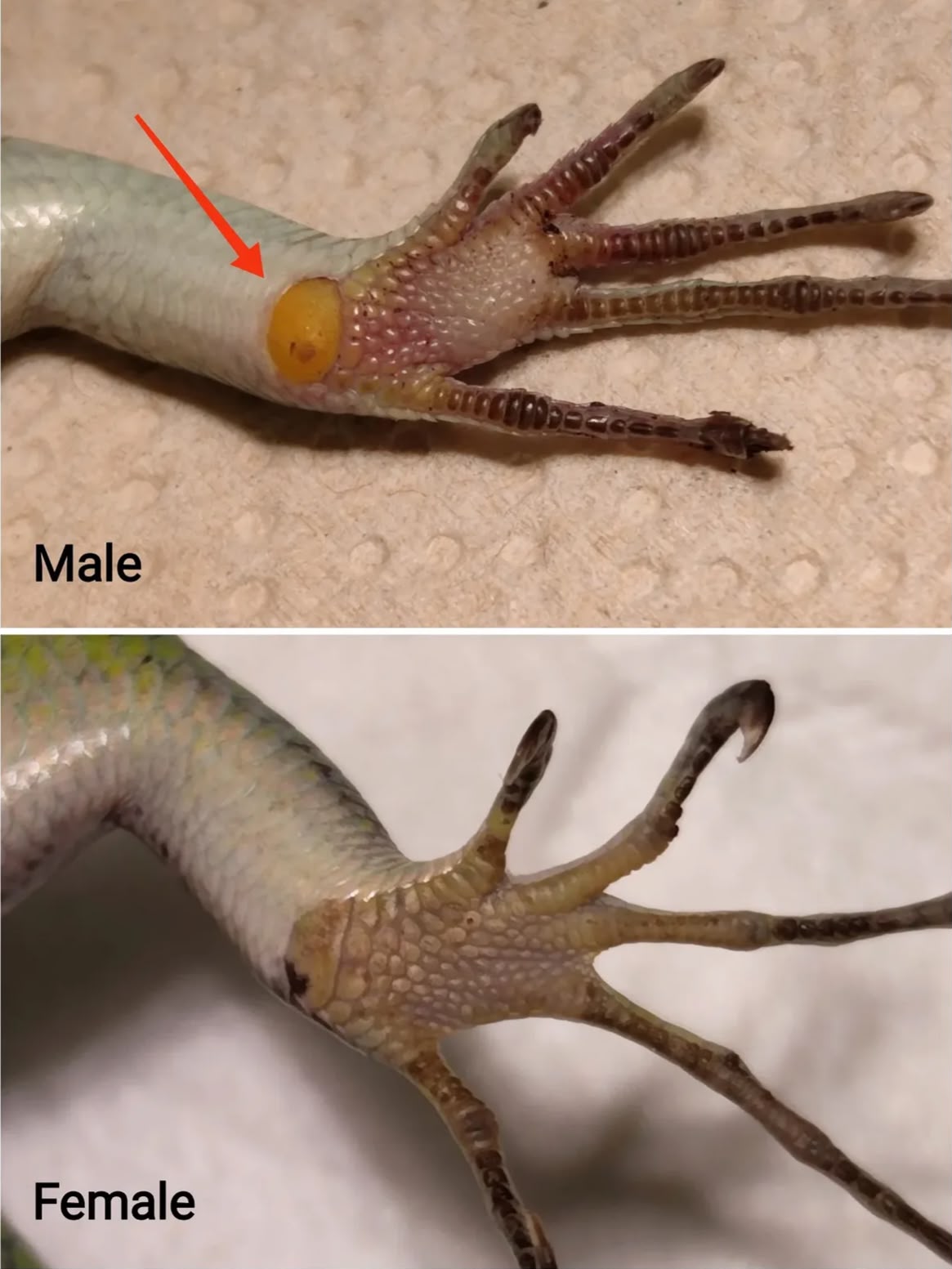
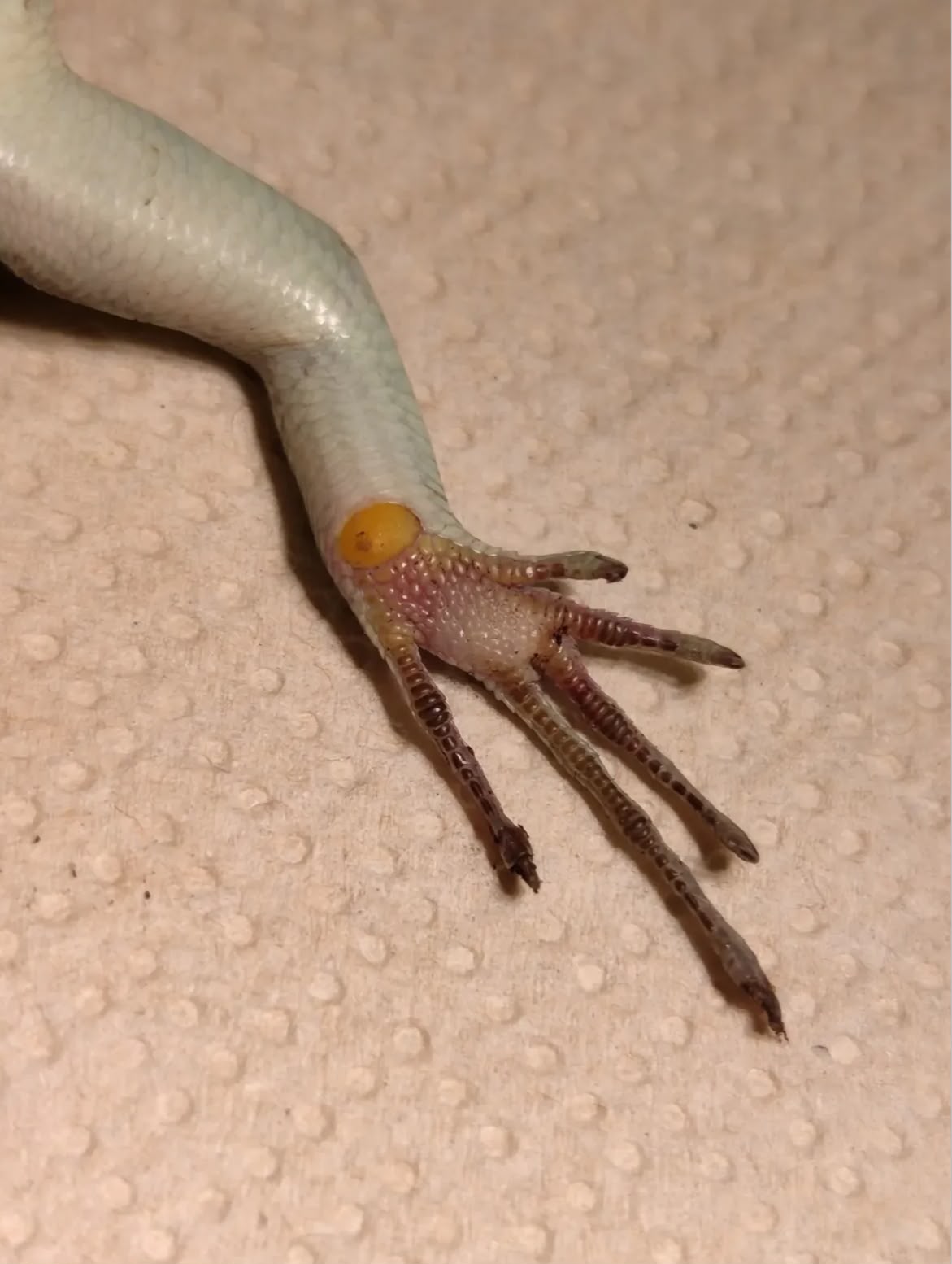
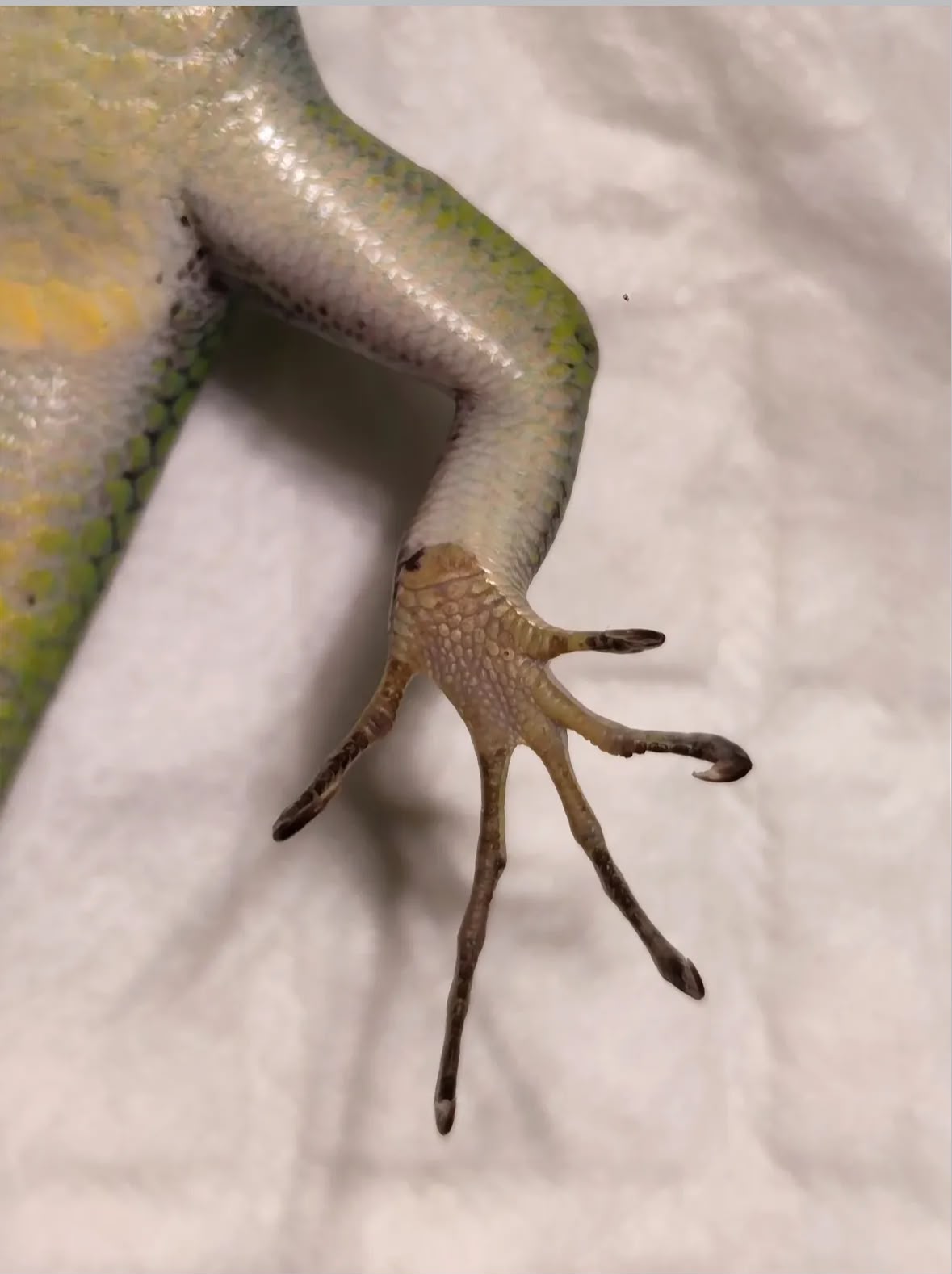
My thanks to Clément Paillusseau, an exotics vet in Paris, for letting me use these. The head-shape difference people often mention is not dependable, and I would not rely on it. This one is.
Pairing & conditioning
- House a compatible male–female pair in a large, richly planted enclosure with multiple basking sites and sightline breaks.
- Ensure both animals are in good condition, healthy weight, well-fed, parasite-free, before breeding is attempted.
- Breed only fully mature adults. In the wild, females did not lay until they reached about 8 cm from snout to vent, tail not counted, so give young animals time to grow up before pairing them (Auffenberg and Auffenberg 1989).
- A mild seasonal cycle (slight variation in temperature, day length and rainfall/misting) can help trigger reproductive behaviour, mimicking the wet/dry rhythm of their range. Wild breeding follows that rhythm closely, with output rising through the second half of the year around the wet monsoon and both sexes showing a seasonal cycle (Auffenberg and Auffenberg 1989).
- Watch closely for aggression; separate if either animal is stressed, injured or losing weight.
Encouraging or discouraging breeding
In their range the temperature barely shifts across the year, with monthly averages sitting around 29 to 32 °C. The big seasonal swing is rainfall, from dry months to the wet monsoons, and wild breeding tracks that rhythm rather than any cool spell (Auffenberg and Auffenberg 1989). So the lever to pull is the wet/dry cycle and the food that follows the rain, not a cold "winter" the way you might cycle a temperate reptile.
To encourage a clutch
- Run a milder, drier spell first for a few weeks: mist less, let humidity sit lower, and keep the warmth up.
- Then bring the rains. Step up misting frequency and duration, or run a rain or fog system, and push humidity high while holding the warm tropical temperatures steady.
- Lift feeding as the rains start, matching the insect flush that follows real rain in the wild.
- A small lengthening of the daylight period can be layered on, but keep it small, because near the equator day length barely moves. Measured across their range it swings by only about 18 minutes over the whole year at Kavieng, roughly an hour at Honiara, and at most an hour and a half at the northern edge of the range. Rain and humidity do most of the work. The terrarium page has the full day length figures per locality.
- Keep the wet phase going for several weeks. In the wild the peak builds through the second half of the year with the monsoon.
To hold breeding back
- Flatten the year. Hold humidity, warmth, light and feeding steady with no pronounced wet spike, sitting nearer the calmer dry-season settings.
- Skip the heavy rain simulation and the post-rain feeding surges that act as the trigger.
- Be realistic about the limits: wild females carried eggs in every month, so steady conditions may only lower the odds rather than switch breeding off. The only certain way to stop a pair breeding is to not house them together.
Eggs & laying
- Egg-laying (oviparous). In the wild it lays small clutches of one to two eggs (mean 1.9, mode 2 in a Philippine field study of 52 females), so almost always a pair, and each egg is laid at roughly 23 by 10 mm (Auffenberg and Auffenberg 1989).
- In the wild it breeds more or less year-round, with gravid females in every month rather than a single tight season, and an earlier study found hatchlings in every month (Alcala 1966). Breeding is not steady across the year, though: the share of breeding females stays low through roughly the first half and then climbs to a strong peak in the second half, with the wet monsoon (Auffenberg and Auffenberg 1989).
- Provide a humid lay site, a moist substrate pocket, leaf litter, or a bark/cork crevice where the female can deposit and cover eggs.
- A gravid female needs extra calcium and reliable warmth; monitor her condition carefully.
Incubation
| Clutch size | One to two eggs (usually 2) |
|---|---|
| Incubation temp | ~27–29 °C (stable, tropical) |
| Substrate | Damp vermiculite / perlite, high humidity |
| Incubation time | Roughly 6–9 weeks |
- Incubate in a controlled incubator for consistency, or leave in a stable bioactive vivarium if conditions are reliable.
- Keep humidity high but avoid eggs sitting in standing water, damp, not wet.
- Don't rotate eggs once development starts.
- Reading a good egg. As long as there is no mould and no discoloration, and the shell stays plain white, the egg is almost always fine (they put it around 90%).
- Temperature. 30 °C is already quite warm. Around 29 °C is the practical ceiling, and they incubate at 27 °C; above 29 °C the young can hatch too early.
- Dimples. A dimple in the shell is normal and fine, though it usually shows up later in incubation, so an early one is a bit soon to read much into.
- Substrate. They normally use perlite rather than vermiculite, though the difference is small and both work.
- Candling. Candling takes patience. Early on you may only make out very fine red veins; in their experience you can see clearly after about a month, or by shining a strong torch through the egg in a fully dark room.
Raising hatchlings
- Set up hatchlings individually or in small groups in smaller, tall, planted enclosures with the same UVB, heat and humidity principles as adults.
- Feed small, appropriately sized feeders (pinhead/small crickets, small BSFL, fruit flies) daily, dusted with calcium.
- Watch closely for competition and uneven growth; separate if some are outcompeting others.
- Prioritise hydration, frequent light misting and plenty of leaf surfaces to drink from.
Wild reproduction figures (clutch size, year-round breeding) are from Auffenberg & Auffenberg (1989), Reproductive Patterns in Sympatric Philippine Skinks, Bulletin of the Florida State Museum 34(5):201–260. Incubation and rearing figures are general keeper guidance, not species-specific published data.
Some of the field detail on this page was surfaced by the community-written Consolidated Emerald Tree Skink Care Guide compiled by u/RutabagaNo9655 on r/EmeraldTreeSkinks, with keeper observations contributed by u/RobHerpTX. Credit to them for pulling it together. I have gone back to the original papers and cite those directly.
Sources & references
- Auffenberg, W. & Auffenberg, T. (1989). Reproductive patterns in sympatric Philippine skinks (Sauria: Scincidae). Bulletin of the Florida State Museum, Biological Sciences 34: 201 to 246. Clutch size, egg dimensions, size at first laying, and the finding that rainfall rather than temperature drives the season.
- Alcala, A. C. (1966). Populations of three tropical lizards on Negros Island, Philippines. PhD thesis, Stanford University. Cited for year-round hatchling records.
- Open-Meteo archive API (ERA5 reanalysis). Day length across the range. Full figures on the terrarium page.