Emerald Tree Skink
Lamprolepis smaragdina (Lesson, 1829)
The emerald tree skink, also called the green tree skink or emerald green skink, is a medium-sized, diurnal, arboreal lizard native to Southeast Asia and the western Pacific. It is the best-known member of the genus Lamprolepis, and one of the more strongly arboreal skinks: Brown and Alcala (1980) described it as almost completely arboreal. That is an unusual lifestyle in a family that is overwhelmingly ground-dwelling or burrowing, and one that skinks have arrived at independently several times.
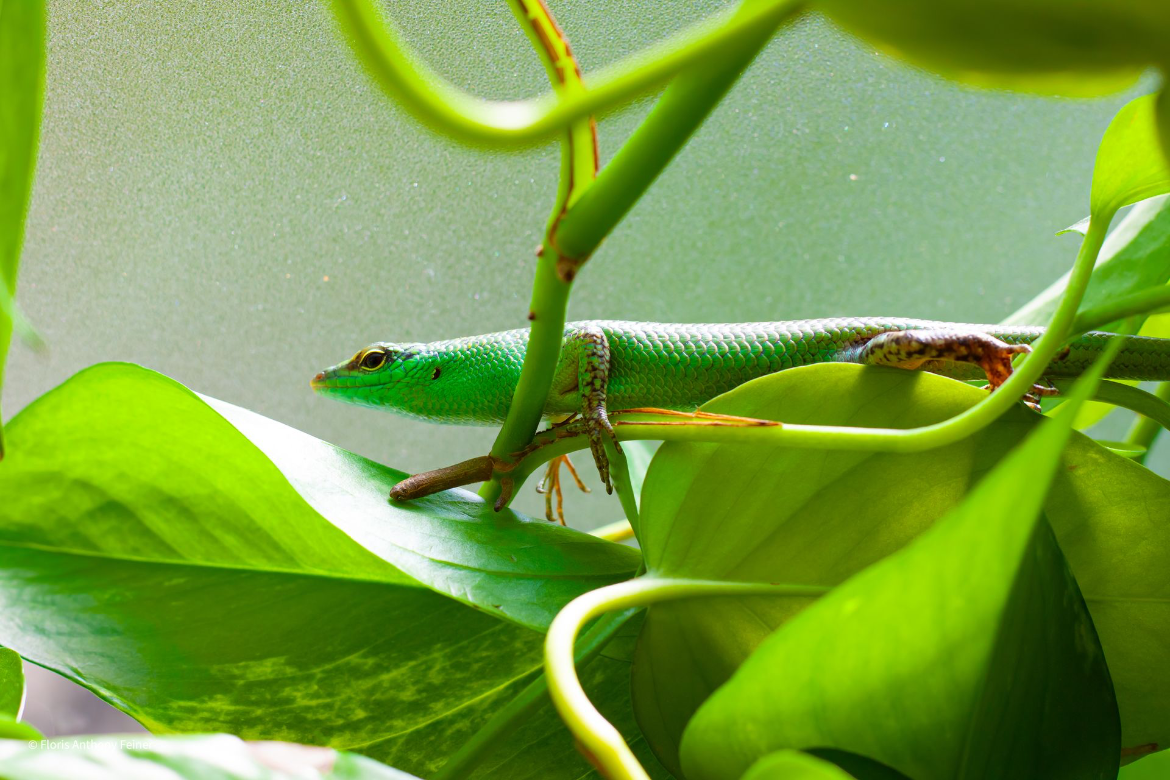
A captive emerald tree skink. The shining green scales and long clawed toes are distinctive. © Floris Anthony Feiner
Identification
- Colour: vivid grass-to-emerald green over the head, back and upper flanks, fading to cream, pale green or yellowish underneath. Some populations carry black or bronze markings on the rear half of the body (see subspecies).
- Build: slender and streamlined with a long, tapering tail roughly as long as the body, built for balance and climbing.
- Limbs & toes: long, well-developed legs and long clawed toes give a strong grip on bark and leaves.
- Head: pointed snout, smooth overlapping scales with a slight metallic sheen (the genus name means "shining scale").
Distribution & habitat
The species ranges across a huge arc of islands: Taiwan, the Philippines (Palawan, Luzon, Davao and Sulu areas), Indonesia (Sulawesi, the Moluccas and surrounding islands), New Guinea, the Bismarck Archipelago, the Solomon Islands, the Santa Cruz Islands and out into parts of Micronesia and other Pacific islands, with an introduced population in the northern Mariana Islands. This wide, fragmented island range is exactly why it shows so much regional variation (Reptile Database; iNature). Genetic studies across the range find sharply structured, deeply divergent island lineages, produced by repeated natural over-water dispersal rather than human transport (Linkem et al. 2013).
Its habitat is warm and humid: lowland forest and forest edge, gardens, village trees, and plantations. Brown and Alcala (1980) recorded it in gardens, coconut and abaca plantations, and dipterocarp and mangrove forest, and in the Philippines it can be one of the most common lizards in such places. It favours bare tree trunks and large branches over dense foliage, and tolerates human-modified landscapes well.
The climate they live in, right now
The four places below all appear in the research cited on this site, and the readings update themselves. Watch them across a year and the temperature hardly moves, which is the single most useful thing to understand about keeping this species.
Live conditions from Open-Meteo (CC-BY 4.0). Updated at 00:41 (just now).
| Ambient (captive target) | 26 to 30 °C |
|---|---|
| Basking spot | 32 to 35 °C |
| Humidity | 60 to 80% |
Air temperature across the range barely shifts between seasons, so the meaningful seasonal signal is rainfall rather than a cool period. Wild breeding tracks that wet cycle instead of a temperature drop, which is why cycling this species like a temperate reptile is a mistake (Auffenberg and Auffenberg 1989).
Behaviour
- Arboreal & diurnal: active by day, high on vertical surfaces; it basks to warm up then forages in bursts.
- Active & alert: fast, inquisitive and endlessly watchable. It's flighty toward people, so it's one to observe rather than handle, but it's far from shy with its own kind.
- Social: lives alongside others and is kept in groups: keep two or more, never alone. Multiple males may spar, so give a group plenty of space, height and cover.
- Caudal autotomy: like many skinks it can shed its tail to escape a predator, regrowing a shorter, often duller replacement.
Senses & vision
The emerald tree skink is a diurnal, visually oriented hunter that locates prey mainly by sight. Its round pupils are typical of active daytime foragers: across animals, round pupils are associated with diurnal pursuit hunters, while vertical slit pupils are associated with nocturnal ambush predators (Banks et al. 2015). Diurnal lizards generally have four-cone colour vision that extends into the ultraviolet, based on a retina with a functional UV-sensitive (SWS1) visual pigment and several oil-droplet types (Pérez i de Lanuza & Font 2014). As an active diurnal species, the emerald tree skink is expected to share this UV-capable colour vision, although its retina has not been examined directly. Vision is supplemented by chemoreception: like other skinks it tongue-flicks to sample chemical cues through the vomeronasal organ.
The eyes are set on the sides of the head, which gives a wide field of view but limited binocular overlap and therefore little stereoscopic depth information. Lizards with this eye placement rely largely on monocular depth cues, chiefly motion parallax: when the head is turned or bobbed, nearer objects move across the visual field faster than more distant ones, which provides a cue to distance. Head movement of this kind is the leading explanation for the head-cocking commonly seen in lizards (Fleishman 2024), and it parallels the side-to-side "peering" that praying mantids use to gauge distance before striking.
Diet in the wild
Primarily insectivorous: beetles, crickets, grasshoppers, moths, caterpillars, spiders and other small invertebrates, supplemented opportunistically with soft fruit, nectar and the occasional small vertebrate. This omnivorous lean is worth replicating in captivity; see the husbandry & diet page.
Field studies put numbers on this. On Siquijor in the Philippines, animals foraged mainly between 09:00 and 14:00 on warm days of 26 to 30 °C, at a density of roughly 44 individuals per hectare in a coconut plantation (Bucol et al. 2011). Across 76 feeding observations in Micronesia, every single one involved arthropods (Perry and Buden 1999). Recorded prey runs to ants, termites, beetles, moths and butterflies, and one animal was seen eating a praying mantis almost as long as itself, which took it over eight minutes. Fruit turns up occasionally, and vertebrates are taken rarely: a raided bird's nest is reported second-hand, and one Siquijor animal was seen feeding on a flying lizard (Draco spilopterus).
Two details matter for keepers. Researchers classify this skink as a widely foraging lizard, meaning it hunts by covering ground rather than waiting in ambush, which is why a bare enclosure frustrates them. And while they are daytime hunters, that is not absolute: Perry and Buden recorded the first documented case of night-light feeding in this species, with animals taking small moths from brightly lit trees, a few sightings around midnight and several at dawn. Activity drops sharply in heavy rain, then picks up again, with animals back to basking roughly half an hour after it stops (Bucol et al. 2011; Perry and Buden 1999).
Names in other languages
Much of the European hobby runs in Dutch, German and French, and the names this species carries in those languages are not translations of one another. A search in one language routinely misses what has been written in the others.
| English | Emerald tree skink, emerald skink, green tree skink |
|---|---|
| Dutch | Smaragdskink |
| German | Smaragdgrüner Glanzskink, Philippinischer Smaragdskink, usually shortened to Smaragdskink |
| French | Scinque émeraude, scinque arboricole émeraude |
| Swedish | Smaragdskink |
| Hungarian | Smaragdszkink |
| Czech | Scink smaragdový |
The Reptile Database gives emerald skink and green tree skink for English, and Smaragdgrüner Glanzskink and Philippinischer Smaragdskink for German (source: Reptile Database). The others are the forms each country's own literature and classified ads use. What changes across Europe is the paperwork rather than the animal, and I have collected what I could verify on the keeping them in Europe page.
Where it sits in the tree of life
Skinks (family Scincidae) are the largest lizard family on Earth. Lamprolepis is a member of the "Mabuya group," a mostly tropical radiation that began in Southeast Asia and later spread to Africa and the Americas. Classifications differ on its rank: the Reptile Database places the genus in the subfamily Lygosominae, while recent molecular phylogenetics places it in Mabuyinae (the Mabuya group), the arrangement shown below (Karin et al. 2016). Below is the full Linnaean classification, followed by two phylogenetic trees showing where L. smaragdina branches.
Describing authority: (Lesson, 1829). The parentheses mean it was first named in another genus. The Reptile Database attributes the species to Lesson, 1829; the date is also cited as 1826 or 1830 because Lesson’s account was published in parts.
Conservation & trade
The IUCN Red List assesses the emerald tree skink as Least Concern (Shea et al. 2021): it is widespread, adaptable and tolerant of human-modified habitat. It is not listed on CITES and is not in the EU wildlife-trade Annexes. It is, however, collected in numbers for the pet trade, where most animals offered for sale are wild-caught, which carries welfare and, locally, sustainability concerns. That is a central reason to prefer captive-bred animals. More on the health & welfare page.
Sources & references
- iNature. Lamprolepis smaragdina (Lesson, 1829). Species profile: description, distribution, size and reproduction.
- Karin, B. R., Metallinou, M., Weinell, J. L., Jackman, T. R. & Bauer, A. M. (2016). Resolving the higher-order phylogenetic relationships of the circumtropical Mabuya group (Squamata: Scincidae): an out-of-Asia diversification. Molecular Phylogenetics and Evolution 102: 220–232. Basis for tree 2 (the Mabuya group) above.
- GBIF. Lamprolepis smaragdina (Lesson, 1829). Accepted taxonomy and occurrence records.
- Banks, M. S. et al. (2015). Why do animal eyes have pupils of different shapes? Science Advances 1:e1500391. Pupil shape and foraging mode.
- Pérez i de Lanuza, G. & Font, E. (2014). Ultraviolet vision in lacertid lizards. Journal of Experimental Biology 217:2899–2909. Four-cone, UV-capable colour vision in diurnal lizards.
- Fleishman, L. J. (2024). Lizard visual ecology. Frontiers in Amphibian and Reptile Science 2:1426675. Depth perception and motion parallax in lizards.
- Linkem, C. W. et al. (2013). Stochastic faunal exchanges drive diversification in widespread Wallacean and Pacific island lizards (Lamprolepis smaragdina). Journal of Biogeography 40:507–520. Phylogeography and over-water dispersal.
- Pyron, R. A., Burbrink, F. T. & Wiens, J. J. (2013). A phylogeny and revised classification of Squamata. BMC Evolutionary Biology 13:93. Basis for the higher-level skink tree (tree 1).
- Shea, G. et al. (2021). Lamprolepis smaragdina. The IUCN Red List of Threatened Species. Assessed as Least Concern.
- The Reptile Database. Lamprolepis smaragdina (Lesson, 1829). Taxonomy, distribution, subspecies and synonymy.
- Brown, W. C. & Alcala, A. C. (1980). Philippine Lizards of the Family Scincidae. Silliman University Natural Science Monograph Series No. 2. Habitat, arboreality and Philippine distribution.
- Bucol, A. et al. (2011). Notes on the biology of the green tree skink Lamprolepis smaragdina philippinica in Siquijor Island, Philippines. Silliman Journal 52(2): 115–121.
- Perry, G. & Buden, D. W. (1999). Ecology, behavior and color variation of the green tree skink, Lamprolepis smaragdina, in Micronesia. Micronesica 31(2): 263–273.
Some of the field detail on this page was surfaced by the community-written Consolidated Emerald Tree Skink Care Guide compiled by u/RutabagaNo9655 on r/EmeraldTreeSkinks, with keeper observations contributed by u/RobHerpTX. Credit to them for pulling it together. I have gone back to the original papers and cite those directly.